3장 · 조직과 전략
이번 강의에서 배울 것
- 조직과 정보기술이 서로 영향을 주는 과정을 설명한다.
- 정보시스템이 거래비용·대리인비용·조직 구조에 미치는 영향을 구분한다.
- 경쟁요인 모형과 가치사슬 모형을 실제 전략 분석에 적용한다.
- 시너지·핵심역량·네트워크 경제와 AI 전략의 관계를 설명한다.
학습 경로
범위: Chapter 3 슬라이드 1–50 · Organization → IT Impact → Competitive Forces → Value Chain → Network Strategy
단원 도입
| 출제 포인트 | 빈도 | 이렇게 나온다 |
|---|---|---|
| Transaction cost vs Agency cost | ★★★ | 상황을 주고 어떤 이론인지 고르기 |
| Porter의 다섯 가지 힘과 네 전략 | ★★★ | 사례에 맞는 힘·전략 고르기, 다섯 힘 쓰기 |
| Value chain의 primary / support activities | ★★★ | 활동 분류하기 |
| Figure 3.7 변화 저항의 네 요소 | ★★ | 네 요소 쓰기, 실패 사례 설명 |
| Technical vs Behavioral definition | ★★ | 정의 구분하기 |
| 다섯 가지 조직 구조 | ★★ | 조직 예시에 맞는 구조 고르기 |
| Network economics · ecosystem · keystone firm | ★ | 용어 정의 |
책 읽는 법: 슬라이드 제목 아래의 짧은 목록과 요약 한 줄이 강의 핵심 필기이고, 그 아래 박스가 이 책의 설명이다. 개념은 정의, 판서는 한눈 정리, 해설은 쉬운 설명, 오답 주의는 시험 함정, 예제는 풀이 연습, 확인 문제는 단원 끝 정답과 해설에서 답을 확인한다.
형광펜 읽는 법: 노랑 핵심 정의·결론 · 빨강 시험에서 헷갈리는 구분·함정 · 파랑 외워야 할 순서·목록
예시 박스 읽는 법: 예시 박스는 슬라이드의 실제 기업 사례와 교수님 메모를 교재 설명으로 보충한 것이다. 시험에서 “이 사례는 어떤 전략·힘·개념인가?”로 나오므로 기업 → 시스템 → 결과 → 개념을 함께 외운다. 장 끝 사례 총정리에 한 표로 모았다. 카페 예시는 이해를 돕는 짧은 가상 사례다.
PART 1 · 조직이란 무엇인가
Slide 1 — Information Systems, Organizations, and Strategy
- Chapter 3 주제: Organizations / Information Technology / Strategy / Competitive Advantage
- 핵심 질문:
- organization은 information systems에 어떤 영향을 주는가?
- information systems는 organization을 어떻게 바꾸는가?
- IT를 competitive strategy에 어떻게 활용하는가?
핵심 흐름: Organization ↔ IT → Organizational Impact → Competitive Forces → Value Chain → Network Strategy
Slide 2 — Learning Objectives
- organization의 technical / behavioral view
- information systems에 영향을 주는 organizational features
- information systems가 organization에 미치는 impact
- Porter’s Competitive Forces Model
- Value Chain Model
- Synergy / Core Competency / Network Economics
- AI와 competitive strategy
- strategic information systems의 challenges
시험 핵심: Organization 이해 → IT impact → Competitive Strategy
Slide 3 — PepsiCo Tames the Doritos Crunch
Problem
- 다른 사람의 Doritos crunch sound가 gamers에게 방해
- 동시에 Doritos fans는 crunch sound를 선호
Solution
- Doritos Silent software tool 개발
- AI / ML로 5,000개 이상 crunch sounds 분석
Result
- gamer segment에서 Doritos popularity 유지
- sales growth 지원
AI/ML을 product experience 개선에 적용한 사례
Slide 4 — Relationship Between Organizations and IT
- Information Technology ↔ Organizations
- 서로 영향을 주는 two-way relationship
Relationship을 결정하는 Factors
- organizational structure
- business processes
- politics
- culture
- environment
- management decisions
IT 도입 효과는 technology 자체보다 organization의 structure / culture / process에 의해 달라짐
교수님 메모: 이 개념은 1장 Figure 1.2·1.4에서 이미 나왔다. 양방향 관계를 매개하는 요인 중 관리자가 내린(또는 내리지 않은) 결정이 특히 중요하다. 두 관계가 미래에 미칠 영향은 예측하기 어렵다 — 예: 15년 전에는 거의 아무도 이메일과 메신저가 비즈니스 소통의 중심이 될 줄 몰랐다.
Slide 5 — Figure 3.1 Two-Way Relationship
Structure
Organizations ↔ Information Technology
중간에 영향을 주는 Mediating Factors:
- Environment
- Culture
- Structure
- Business Processes
- Politics
- Management Decisions
Organization과 IT의 관계는 직접적이지 않고 여러 organizational factors가 매개
교재 그림 · Figure 3.1
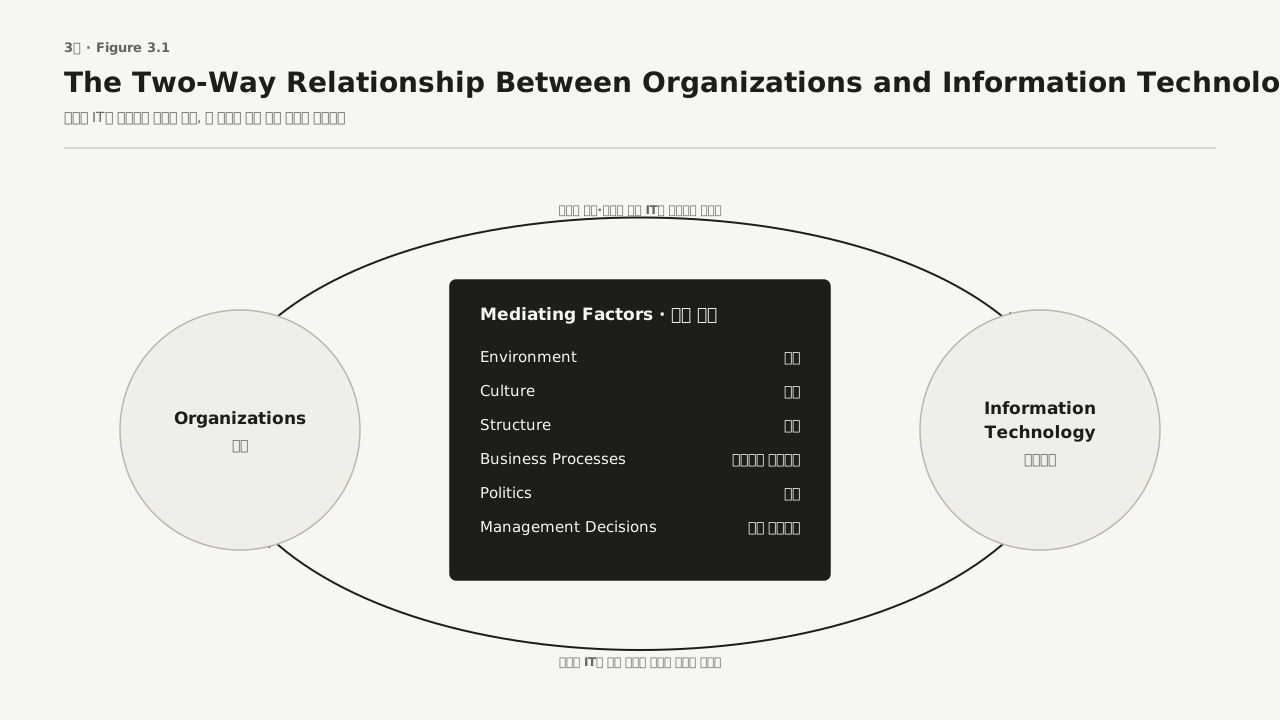
Figure 3.1 · The Two-Way Relationship Between Organizations and Information Technology — 조직과 IT 사이를 여섯 가지 매개 요인이 조정한다.
개념도 · 조직과 IT의 양방향 인과관계
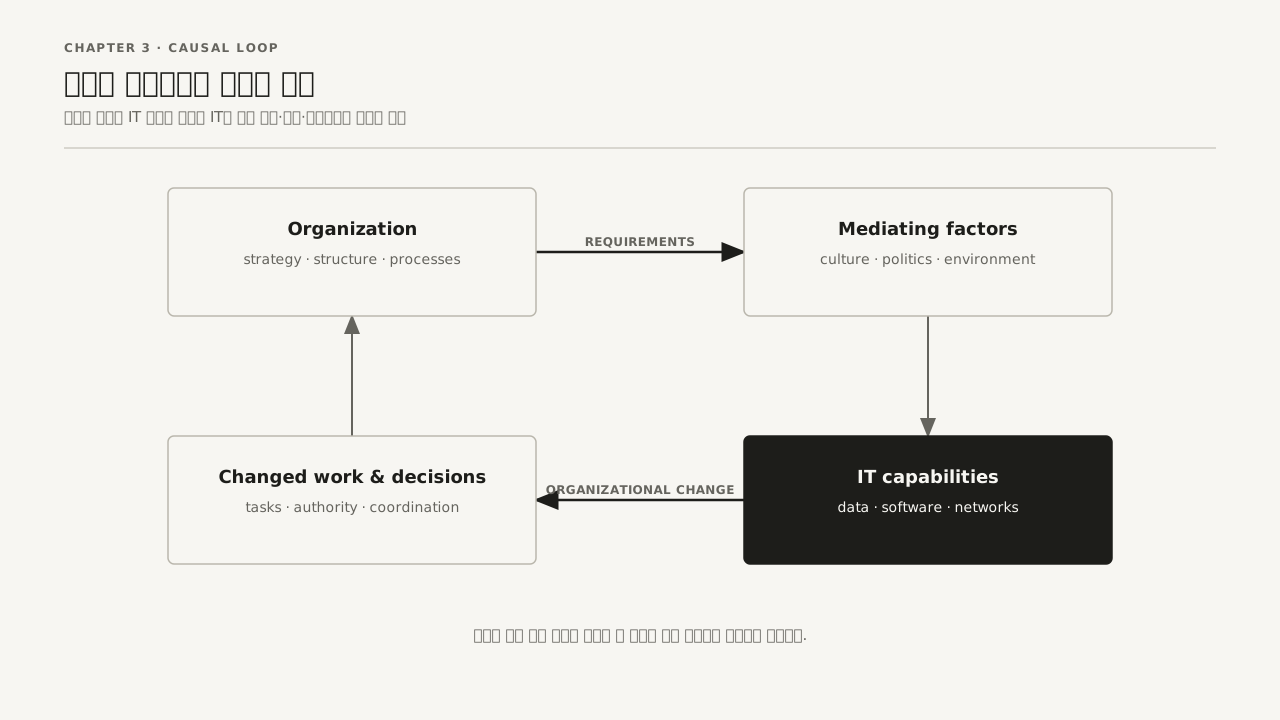
그림 읽기: 조직은 전략·구조·프로세스를 통해 시스템 요구사항을 만들지만, 실제 설계는 문화·정치·환경·관리자의 판단 같은 매개 요인의 영향을 받는다. 도입된 IT는 다시 업무, 권한, 조정 방식과 의사결정을 바꾼다. 그러므로 성과나 저항을 기술의 기능만으로 설명하면 순환의 절반을 놓친다.
Slide 6 — What Is an Organization?
| 관점 | 정의 |
|---|---|
| Technical Definition | environment에서 resources를 받아 production process를 통해 outputs를 만드는 formal social structure |
| Behavioral Definition | rights / privileges / obligations / responsibilities가 conflict와 resolution을 통해 유지되는 social system |
Key
- Technical view와 Behavioral view는 complementary
- 둘 중 하나만으로 organization을 완전히 설명할 수 없음
Technical = input → process → output / Behavioral = people + rights + conflict + relationships
슬라이드 원문: Technical definition의 다른 표현 — 내부 규칙과 절차를 가진 공식적인 법적 실체(formal legal entity)이자 사회 구조. Behavioral definition — 권리·특권·의무·책임이 갈등과 갈등 해결을 통해 오랜 시간에 걸쳐 섬세하게 균형 잡힌(delicately balanced) 집합. 교수님 메모: 두 정의는 서로 보완적이므로 하나만 쓰지 말고 둘 다 고려한다.
Slide 7 — Figure 3.2 Technical Microeconomic Definition
Flow
Inputs from Environment
- capital
- labor
↓
Organization
- production process
↓
Outputs to Environment
- products
- services
↓
feedback → 다시 capital / labor 제공
특징
- organization을 쉽게 재배열 가능한 system으로 봄
- human factor는 거의 고려하지 않음
Technical view = organization을 production machine처럼 보는 관점
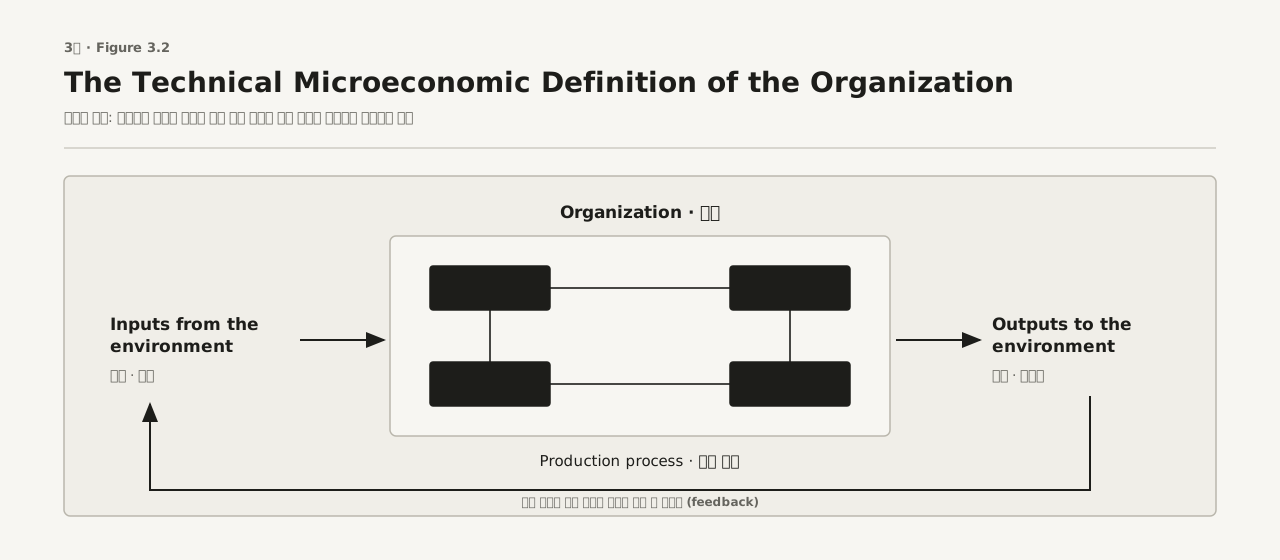
Figure 3.2 · The Technical Microeconomic Definition of the Organization — 조직을 생산 기계처럼 보는 관점.
Slide 8 — Figure 3.3 Behavioral View
Formal Organization 구성
- Structure
- Hierarchy
- Division of labor
- Rules / procedures
- Business processes
- Culture
- Rights / obligations
- Privileges / responsibilities
- Values
- Norms
- People
특징
- organization 변화가 쉽지 않음
- hierarchy / rules / contracts / culture 때문에 변화에 시간 필요
Behavioral view = organization을 사람·관계·문화가 얽힌 social system으로 보는 관점
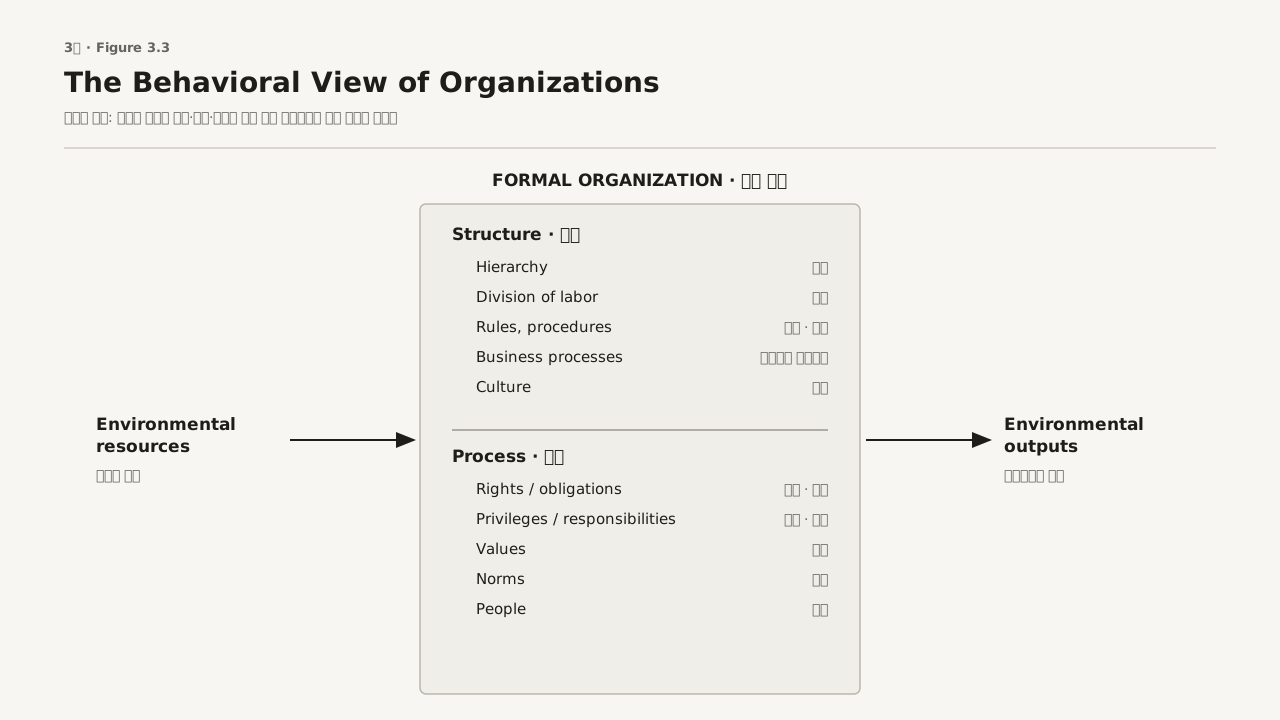
Figure 3.3 · The Behavioral View of Organizations — 구조와 함께 권리·의무·가치·규범·사람이 조직을 이룬다.
Slide 9 — Features of Organizations
- hierarchical structure 사용
- accountability / authority
- impartial decision making
- efficiency 원칙 추구
- routines / business processes
- organizational politics
- organizational culture
- organizational environments
- organizational structure
대부분의 organization은 hierarchy + routines + rules + culture를 기반으로 운영
교수님 메모: Accountability는 4장에서 나오는 시스템과 사회 제도의 특징으로, 누가 책임 있는 행동을 했고 누가 책임지는지 가려내는 메커니즘이 있다는 뜻이다(교재 p.159). impartial은 unbiased(편향 없는)라는 뜻. 생각해 볼 것: 위계 구조가 없는 조직(일이 진행될까?), 효율 원칙을 지키지 않는 조직(쓸 만한 제품을 적정 가격에 낼 수 있을까?)은 어떻게 될까?
Slide 10 — Routines and Business Processes
Routines
- Standard Operating Procedures (SOPs)
- expected situations에 대응하기 위한 precise rules / procedures / practices
관계
Routines ↓ Business Processes ↓ Business Firm
- business process = routines의 collection
- firm = business processes의 collection
Routine → Business Process → Firm
교수님 메모 · 슬라이드 예: 잘 정해진 루틴의 예는 병원(doctor's office)이다. 접수원, 간호사, 의사가 각각 정해진 루틴을 가지고 있다.
Slide 11 — Figure 3.4 Routines, Business Processes, and Firms
Structure
Individual Routines → 여러 routines가 모여 → Business Process
여러 business processes → Business Firm
IT 도입 시
- 새로운 information system이 효과를 내려면
- routines 변화
- business processes 변화 가 필요
새로운 IS 도입 = 기존 routine과 process까지 함께 바뀌어야 함
교재 그림 · Figure 3.4
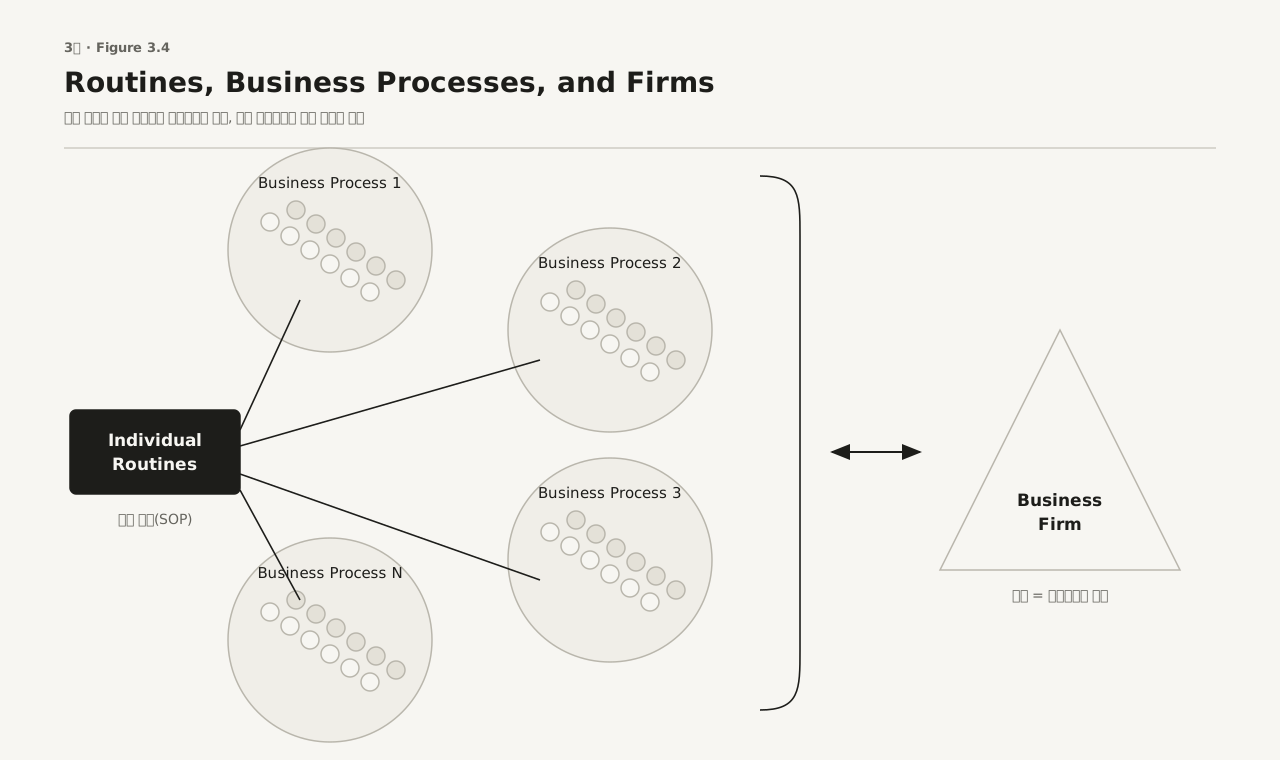
Figure 3.4 · Routines, Business Processes, and Firms — 루틴의 묶음이 프로세스, 프로세스의 묶음이 기업이다.
개념도 · Routine에서 Firm까지의 포함 관계
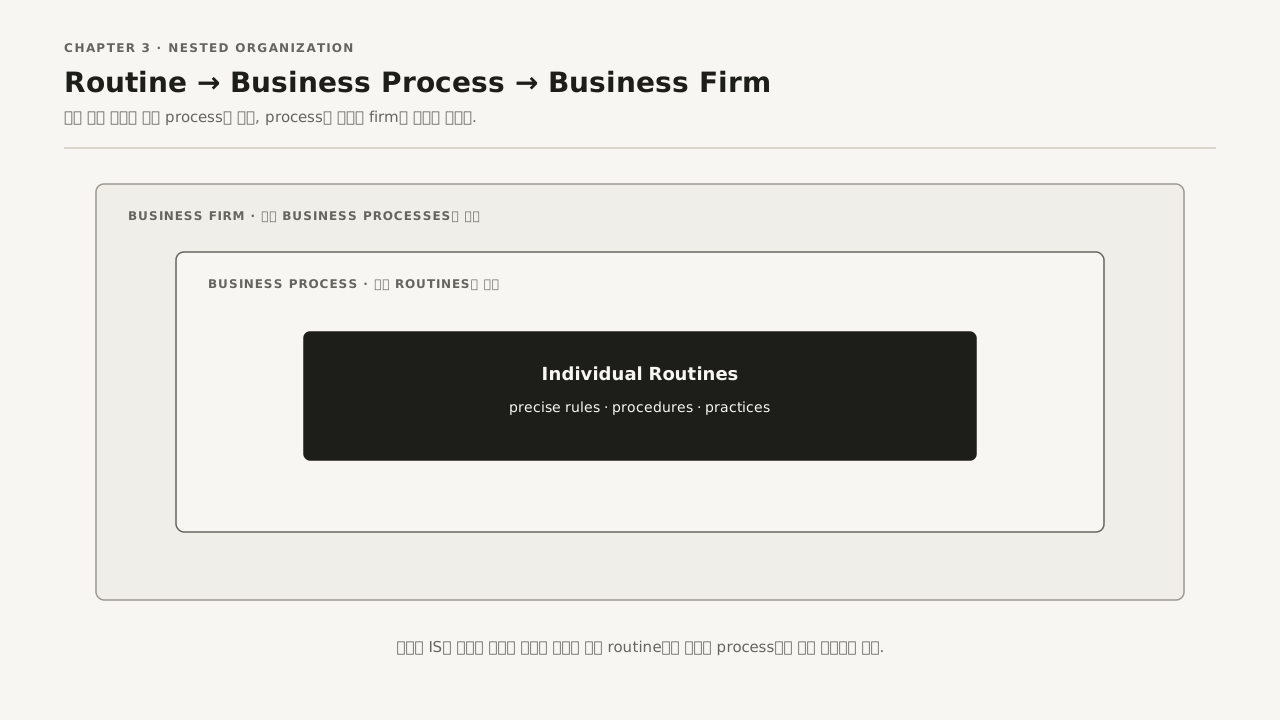
안쪽의 routine이 바뀌지 않으면 바깥쪽 process도 실제로 달라지기 어렵다. 이 포함 관계 때문에 IS 도입은 기술 설치와 업무 방식의 변화를 함께 다뤄야 한다.
Slide 12 — Organizational Politics
- organization 내부에는 서로 다른 viewpoints / interests 존재
- 이 차이 → political struggle / competition / conflict
- political resistance는 organizational change를 방해
Information system 변화는 power와 information access를 바꾸므로 politics와 충돌하기 쉬움
Slide 13 — Organizational Culture
- organization 구성원들이 공유하는 basic assumptions
- 다음을 정의:
- 무엇을 생산할 것인가
- 어떻게 / 어디서 생산할 것인가
- 누구를 위해 생산할 것인가
Effect
- organization을 통합하는 force
- 동시에 change를 막는 restraint
- 특히 technological change에 저항 가능
Culture = organization이 당연하다고 믿는 기본 가정
슬라이드 판서: 문화 = 구성원들이 기반암(bedrock)처럼 공격할 수 없고(unassailable), 의심하지 않는(unquestioned) 가정. 교수님 메모: 문화는 추상적으로 보이지만 특히 기술 변화(technological change)에 대한 제약이 된다.
Slide 14 — Organizational Environments
- organization과 environment는 reciprocal relationship
- organization은 social / physical environment에 의존
- organization도 environment에 영향 가능
- environment는 보통 organization보다 더 빠르게 변화
Information Systems
- environmental scanning 지원
- environment를 보는 lens 역할
IS = 외부 변화를 감지하는 organization의 lens
교수님 메모: Environmental scanning(환경 탐색)은 조직의 대응이 필요할 수 있는 외부 변화를 찾아내고 판단하는 것이다. 예: 현재의 경제 상황(economic climate)은 생존을 위해 대대적인 조직 대응이 필요한 외부 변화다. Figure 3.5 메모: IS는 기업의 "lens"로서 외부 요인을 관찰해 정보를 기업 안으로 걸러 보낸다. 어느 정도 조직은 시스템이 보여 주는 것만 “본다”. 시스템이 부실하면 관리자가 문제를 보지 못하게(blind) 만들 수 있다.
Slide 15 — Figure 3.5 Environments and Organizations
Environment
- Governments
- Competitors
- Customers
- Financial Institutions
- Culture
- Knowledge
- Technology
↓
Information Systems
↓
Firm
Key
- IS가 외부 정보를 filter해서 firm에 전달
- poorly designed system → 중요한 변화나 문제를 놓칠 수 있음
Organization은 IS를 통해 environment를 인식하고 대응
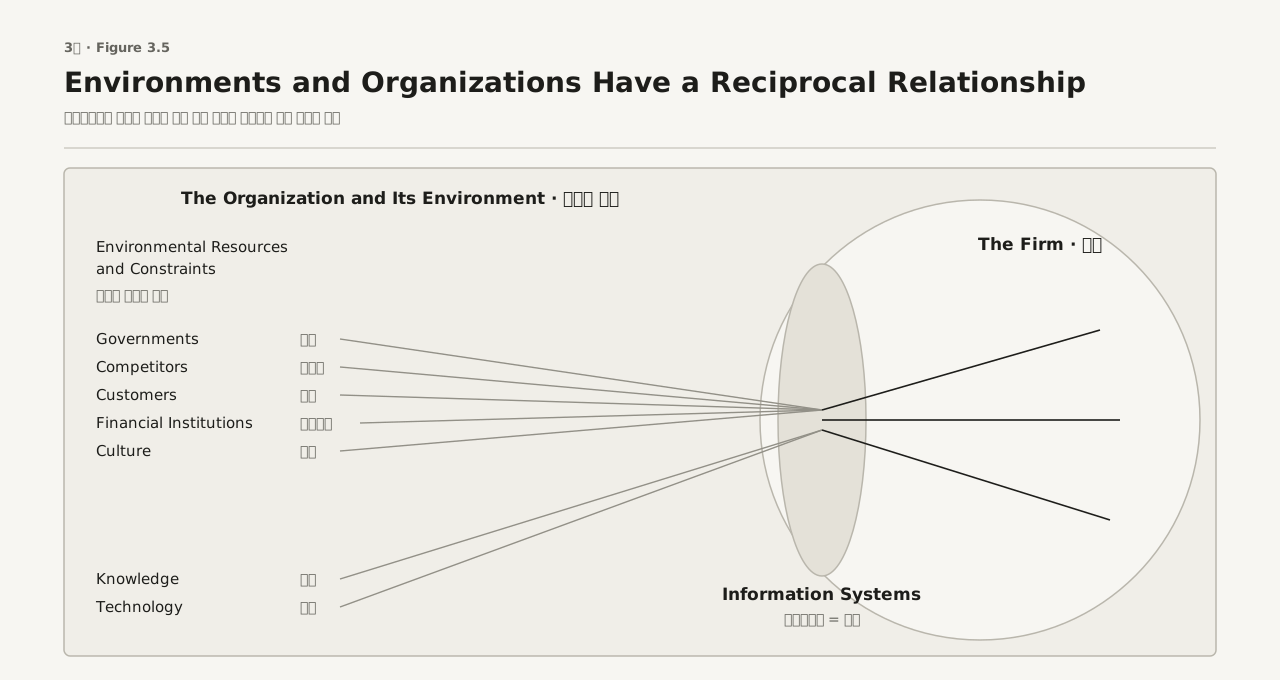
Figure 3.5 · Environments and Organizations Have a Reciprocal Relationship — IS는 환경을 보는 렌즈다.
Slide 16 — Disruptive Technologies
Disruptive Technology
- 기존 제품과 비슷하거나 더 나은 substitute
- business / industry / market에 sweeping change 발생
Examples
- personal computers
- smartphones
- Big Data
- artificial intelligence
- Internet
First Movers vs Fast Followers
| 구분 | 의미 |
|---|---|
| First Mover | disruptive technology의 inventor |
| Fast Follower | 규모와 resources를 활용해 technology를 빠르게 commercialize |
기술을 처음 만든 기업이 항상 최종 승자는 아님
Slide 17 — Organizational Structure
Five Basic Structures
| Structure | Example |
|---|---|
| Entrepreneurial Structure | small start-up |
| Machine Bureaucracy | midsize manufacturing firm |
| Divisionalized Bureaucracy | Fortune 500 firm |
| Professional Bureaucracy | law firm / school / hospital |
| Adhocracy | consulting firm |
- information system은 organization structure를 반영하는 경우가 많음
- 출처: Mintzberg(1979)의 다섯 가지 기본 구조. 슬라이드 판서: adhocracy는 중앙 관리·권한이 약한(weak central management or authority) 구조. 모든 조직은 구조(모양)를 가진다.
Organization structure가 다르면 필요한 IS도 달라짐
Slide 18 — Other Organizational Features
- Goals
- coercive
- utilitarian
- normative
- Constituencies
- Leadership styles
- democratic / authoritarian
- Task types
- routine / non-routine
- Environments
같은 IT라도 goal / leadership / task / environment가 다르면 효과도 달라짐
교수님 메모(슬라이드 원문 짝): prisons → coercive, businesses → utilitarian, colleges → normative. 이 세 쌍은 순서대로 그대로 외운다.
PART 2 · IT가 조직을 어떻게 바꾸나
Slide 19 — Economic Impacts of IS
- IT는 capital cost / information cost 변화시킴
- IS technology도 capital / labor처럼 factor of production
- IT는 information의 cost / quality에 영향
핵심 효과
- transaction costs 감소
- outsourcing 가능성 증가
- firm이 smaller size로 운영 가능
IT는 information과 market participation cost를 낮춰 firm의 경제적 구조를 변화시킴
교수님 메모: Transaction cost = 기업이 스스로 만들 수 없는 것을 시장에서 살 때 드는 비용. 시간이 지날수록 IT가 더 많은 중간관리자의 기능을 대체하고, 건물·기계 같은 다른 자본의 필요도 줄일 것이다. “economics of information(정보의 경제학)”의 의미와 IT 때문에 outsourcing이 가능해지는 이유를 설명할 수 있어야 한다.
Slide 20 — Transaction Cost Theory
Transaction Cost
- market에 참여할 때 발생하는 비용
- supplier 탐색
- contract 작성
- quality 확인
- monitoring 등
Traditional Response
- transaction cost가 높으면
- vertical integration
- employees 증가
- suppliers / distributors 인수
IT Effect
- IT / Internet → transaction cost 감소
- 외부 firm과 거래하는 것이 더 경제적
IT ↓ Transaction Cost → market outsourcing ↑ → firm size 축소 가능
교수님 메모 (슬라이드 원문 흐름): 시장을 쓰는 것은 비쌀 수 있다. 직원을 고용하지 않고 시장에 의존하면 인재를 찾고, 공급자·작업자의 품질을 조사하고, 계약서를 쓰고, 작업을 감시해야 한다. 시장 참여가 비싸면 기업은 차라리 직원을 고용한다. 그런데 인터넷이 시장 이용을 싸게 만들어, 직원을 고용하기보다 시장에서 계약하는 것이 더 비용 효율적이 되었다. 생각해 볼 질문: 인터넷은 왜 시장 참여를 예전보다 싸게 만드는가?
Slide 21 — Agency Theory
Agency Cost
- employees / agents를 manage + supervise하는 비용
- firm이 커질수록 agency cost 증가
IT Effect
- monitoring / coordination 비용 감소
- managers / employees를 크게 늘리지 않고도 firm 확장 가능
IT ↓ Agency Cost → larger firm을 더 적은 management cost로 운영 가능
슬라이드 원문: 기업은 감독이 필요한 자기 이익 추구자들 사이의 계약의 결합체(nexus of contracts among self-interested parties)다. 교수님 메모: 직원을 끊임없는 감독이 필요한 독립적인 대리인(independent agents)으로 보기 때문에, agency theory는 기업이 커질수록 직원 관리에 더 많은 노력이 들어 비용이 늘어나는 이유를 강조한다. IT는 내부 관리 비용도 줄인다.
두 이론은 비용이 생기는 조직의 경계가 다르다. Transaction cost는 외부 공급업체를 찾고 계약·거래하는 비용이고, agency cost는 내부 구성원의 일을 조정·감독하는 비용이다. IT가 어느 비용을 낮추는지에 따라 외부와 협력하기 쉬워질 수도, 내부 조직을 더 넓게 관리하기 쉬워질 수도 있다.
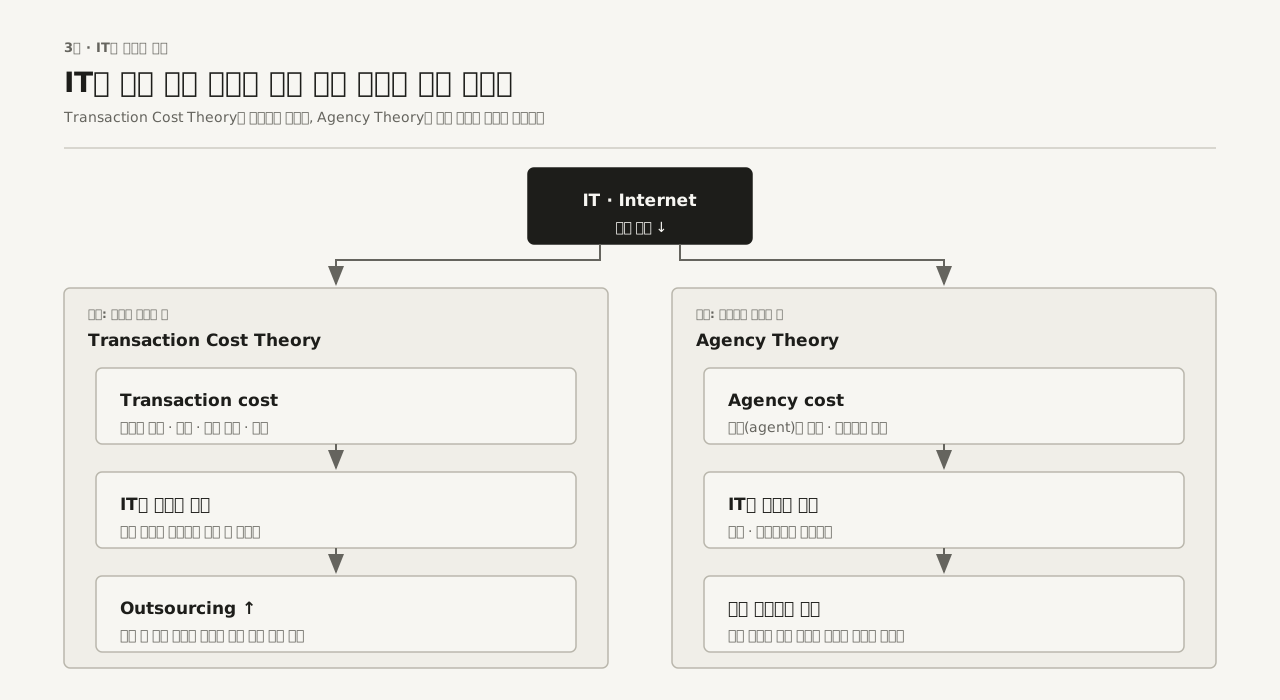
그림 읽기: 왼쪽은 회사 바깥과 거래하는 비용, 오른쪽은 회사 안쪽의 직원을 관리하는 비용이다. IT는 두 비용을 모두 낮추지만 결과는 반대 방향일 수 있다. 바깥 거래가 싸지면 외부에 맡기며 작아지고, 안쪽 관리가 싸지면 관리자를 크게 늘리지 않고도 커질 수 있다.
Slide 22 — Organizational and Behavioral Impacts
IT Flattens Organizations
- decision making이 lower level로 이동
- fewer managers 필요
- manager의 span of control 증가
Postindustrial Organization
- authority가 formal position보다
- knowledge
- competence 에 기반
IT → hierarchy 감소 + lower-level empowerment 증가
Slide 23 — Figure 3.6 Flattening Organizations
Traditional Hierarchy
- management layers 많음
- information 전달 단계 많음
↓
Flattened Organization
- management layers 감소
- lower-level employees의 decision authority 증가
Benefits
- faster information flow
- fewer managers
- lower agency costs
- faster decisions
IS는 hierarchy를 줄이고 organization을 flatter하게 만들 수 있음
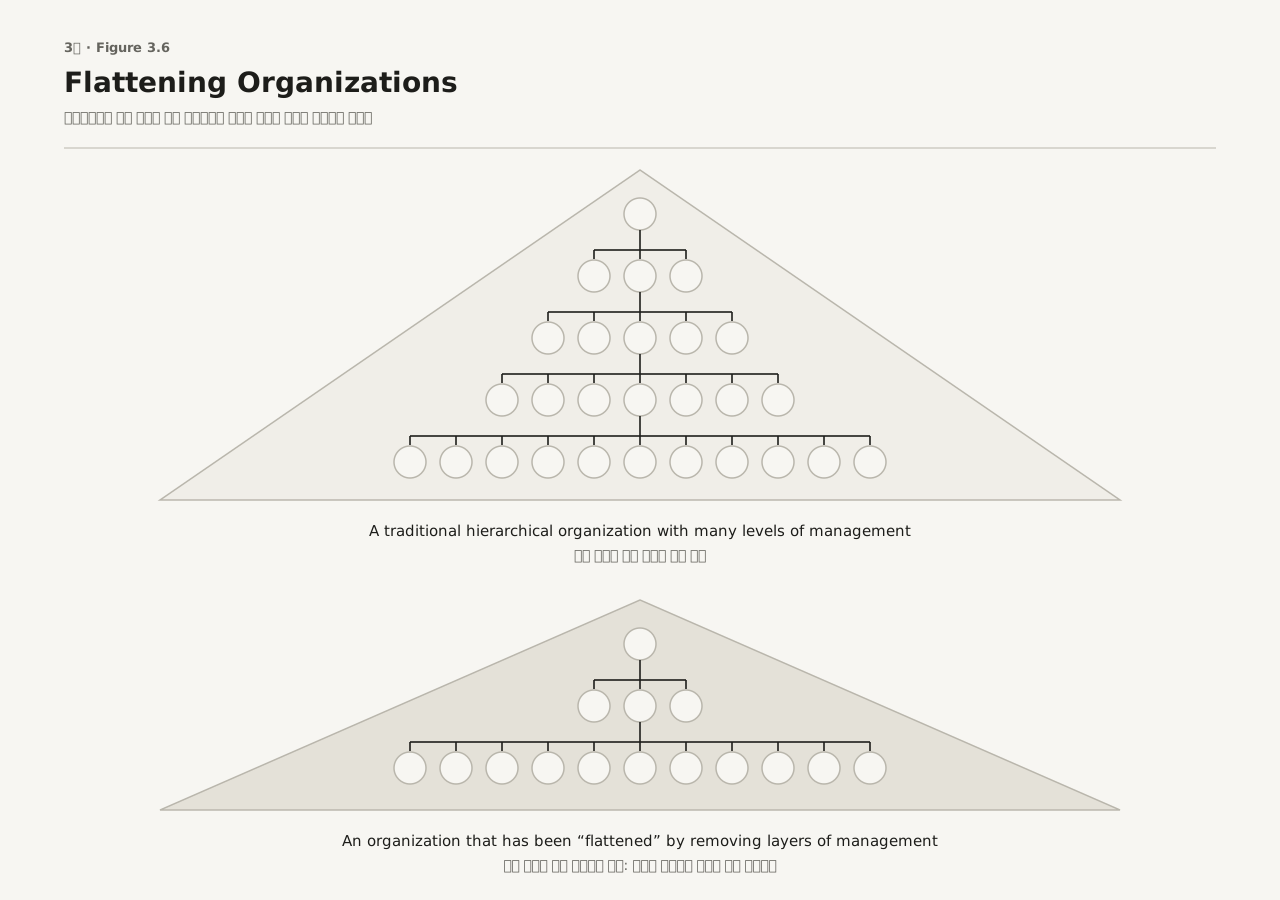
Figure 3.6 · Flattening Organizations — 관리 계층을 없애 조직이 납작해진다.
Slide 24 — Organizational Resistance to Change
IS가 resistance를 만드는 이유
- information access 변화
- structure / culture / politics / work 변화
Project Failure 주요 원인
- organizational / political resistance
Four Factors
- nature of innovation
- organizational structure
- organizational culture
- tasks affected
Large IS project 실패는 technical problem보다 organizational resistance 때문인 경우가 많음
교수님 메모: IS는 핵심 자원인 정보(information)에 대한 접근을 좌우하기 때문에 조직 정치에 얽힌다. 예: 직원들은 자기 루틴을 깨뜨리는 변화에 저항할 수 있다. 관리자에게는 IS의 기술적 이해만큼 IS의 영향을 받는 사람·조직 구조·관습을 이해하는 것이 중요하다.
Slide 25 — Figure 3.7 Resistance to IS Innovations
Four Components
- People
- Organizational Structure
- Job Tasks
- Information Technology
Key
- 하나만 바꾸면 안 됨
- successful change를 위해 네 요소를 simultaneously 조정
IS change = Technology + People + Structure + Tasks의 동시 변화
새 시스템이 정보를 더 빨리 보여 주더라도 기존의 승인 권한이나 업무 분담을 그대로 두면 결정은 여전히 늦을 수 있다. 반대로 담당자의 일이 달라지는데 교육과 책임 범위가 정해지지 않으면 저항이 생긴다. 시스템 도입을 화면 교체가 아니라 업무 변화로 읽어야 하는 이유다.
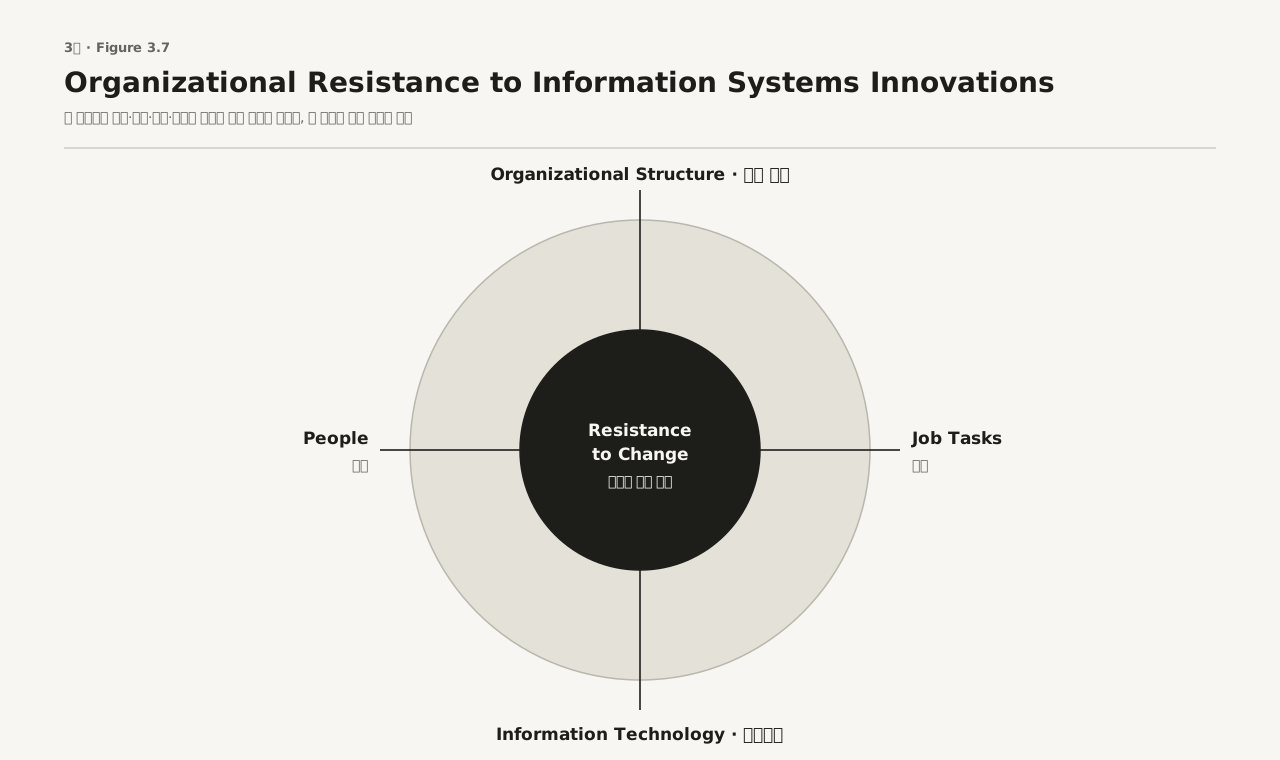
Figure 3.7 · Organizational Resistance to Information Systems Innovations — 네 요소가 함께 바뀌어야 저항이 줄어든다.
그림 읽기: 네 요소는 서로 줄로 묶여 있다. 기술(IT)만 바꾸고 권한 구조, 업무 순서, 사람의 역량을 그대로 두면 나머지 셋이 기술을 원래 방식으로 끌어당긴다. 그래서 도입 계획에는 교육(people), 권한 재조정(structure), 업무 재설계(job tasks)가 함께 들어가야 한다.
Slide 26 — The Internet and Organizations
Internet Effects
- information / knowledge의
- accessibility 증가
- storage 확대
- distribution 개선
- transaction costs 감소
- agency costs 감소
Example
- corporate website로 manuals 배포
- distribution cost 절감
Internet → information cost ↓ + transaction/agency cost ↓ + organization flattening
Slide 27 — Designing Information Systems
New System 설계 시 고려할 Organizational Factors
- Environment
- Structure
- hierarchy
- specialization
- routines
- business processes
- Culture / Politics
- Organization type / Leadership style
- Interest groups / End-user attitudes
- Tasks / Decisions / Business Processes
좋은 IS 설계는 technical design보다 organizational fit이 중요
슬라이드 메모: 예: 회사의 문화와 정치를 이해하지 못하고 설계한 시스템은 인기가 없을 가능성이 크고, 직원들이 기존 루틴에서 크게 벗어나도록 강요할 수 있다.
PART 3 · 경쟁 전략
Slide 28 — Porter’s Competitive Forces Model (1/3)
Purpose
- 어떤 firm이 industry leader가 되는지 설명
- firm / competitors / environment를 함께 분석
Five Competitive Forces
- Traditional Competitors
- New Market Entrants
- Substitute Products & Services
- Customers
- Suppliers
Competitive Advantage는 direct competitor뿐 아니라 5가지 industry forces로 결정
교수님 메모: Porter 모형은 왜 어떤 기업은 다른 기업보다 잘하는가를 설명하려는 것이다. 판서 키워드: Competitive advantage. 생각해 볼 질문: 다섯 요인 중 기업의 성공에 가장 중요한 것은?
Slide 29 — Porter’s Model (2/3)
Traditional Competitors
- 기존 competitors는 지속적으로
- new products
- services
- efficiencies
- switching costs 개선
New Market Entrants
- industry마다 entry barrier가 다름
- new entrant 특징
- new equipment
- younger workers
- low brand recognition
기존 경쟁자 + 신규 진입자가 firm의 competitive pressure를 높임
슬라이드 예: 진입 장벽이 높은 산업의 예 = 컴퓨터 칩(computer chip) 사업.
Slide 30 — Porter’s Model (3/3)
Substitute Products & Services
- 가격이 높아지면 customer가 선택할 대체재
Customers
- competitor product로 쉽게 switch 가능한가?
- price competition을 강요할 수 있는가?
Suppliers
- supplier price 상승을 firm이 그대로 반영하기 어려우면 supplier power 증가
Substitute / Customer / Supplier power가 높을수록 firm의 competitive pressure 증가
Slide 31 — Figure 3.8 Porter’s Competitive Forces Model
| Force | 핵심 질문 |
|---|---|
| Traditional Competitors | 기존 경쟁 강도는 얼마나 큰가? |
| New Entrants | 신규 기업이 쉽게 들어올 수 있는가? |
| Substitutes | 대체 제품으로 쉽게 이동할 수 있는가? |
| Customers | customer bargaining power가 큰가? |
| Suppliers | supplier bargaining power가 큰가? |
Firm strategy는 industry의 5 Forces에 대응하도록 설계
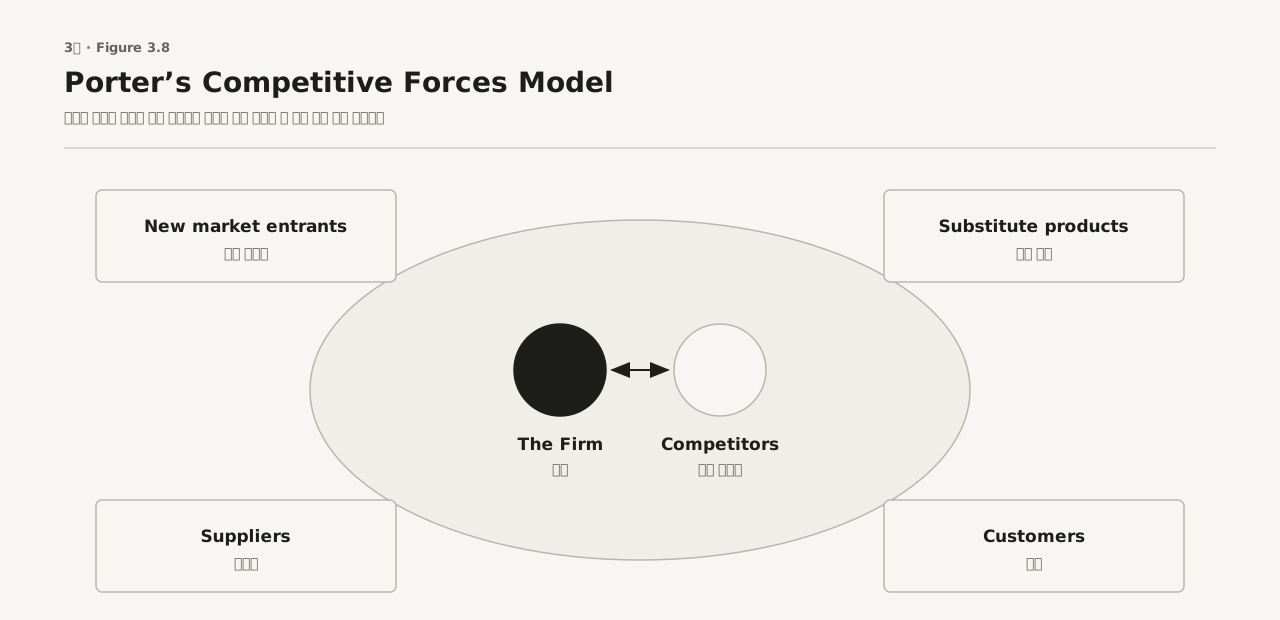
Figure 3.8 · Porter’s Competitive Forces Model — 기존 경쟁자 외에 네 가지 힘이 기업의 전략적 위치를 정한다.
그림 읽기: 가운데 타원 안의 기업과 기존 경쟁자를 네 힘이 둘러싸고 있다. 분석할 때는 각 힘에 “이 힘은 강한가, 약한가?”를 묻고, 가장 강한 압력부터 대응 전략을 고른다. 대응 전략 네 가지가 다음 슬라이드의 내용이다.
Slide 32 — IS Strategies for Competitive Forces
Four Generic Strategies
- Low-Cost Leadership
- Product Differentiation
- Focus on Market Niche
- Customer & Supplier Intimacy
IT를 competitive advantage로 연결하는 4가지 기본 전략
Slide 33 — Low-Cost Leadership / Product Differentiation
| Strategy | 의미 | Example |
|---|---|---|
| Low-Cost Leadership | competitor보다 낮은 cost로 product/service 제공 | Walmart |
| Product Differentiation | 새로운 product/service 또는 superior experience 제공 | Google / Nike / Apple |
Product Differentiation 관련
- Mass Customization
- mass production resources를 사용하면서 personalized product/service 제공
- customer experience management
Low Cost = efficiency / Differentiation = uniqueness & experience
Slide 34 — Market Niche / Customer & Supplier Intimacy
Focus on Market Niche
- 특정 segment에 집중
- IS로 detailed customer data 분석
- CRM analytical capability 활용
- Example: Hilton OnQ
Customer & Supplier Intimacy
- customer / supplier와 강한 relationship 형성
- loyalty 증가
- switching cost 증가
- Examples: Toyota / Amazon / Starbucks
Niche = 좁은 target에 집중 / Intimacy = 관계 강화로 switching cost 증가
Slide 35 — Internet’s Impact on Competitive Advantage
- 일부 industry를 transform 또는 threaten
- travel agency
- printed encyclopedia
- media
- competitive forces는 여전히 존재
- rivalry는 더 intense
- universal standards → new entrants 증가
- 동시에 brand / customer loyalty 구축 기회도 증가
Internet은 경쟁을 없애지 않고 오히려 rivalry와 entry pressure를 강화
Slide 36 — Smart Products and IoT
Internet of Things (IoT)
- product 내부의 Internet-connected sensors 증가
Smart Products
- information-intensive services와 연결된 products
- examples:
- fitness equipment
- health trackers
Competitive Impact
- product differentiation 기회 증가
- switching costs 증가
- new entrants 억제 가능
- supplier power 감소 가능
- competitors 간 rivalry 증가 가능
IoT는 product를 단순 물건에서 data-driven service platform으로 확장
PART 4 · 가치사슬과 네트워크 전략
Slide 37 — The Value Chain Model
Value Chain
- firm을 value를 추가하는 activities의 연속으로 봄
Two Types
- Primary Activities
- Support Activities
활용 목적
- 어느 activity에 IS를 적용하면 competitive advantage가 큰지 찾음
- operational efficiency 개선
- customer / supplier intimacy 개선
- benchmarking / best practices 활용
Porter Model과 차이
- Porter = industry-level competitive pressure 분석
- Value Chain = firm 내부에서 구체적으로 어디를 개선할지 분석
Porter는 ‘어떤 힘과 경쟁하는가’, Value Chain은 ‘어디를 개선할 것인가’
두 모형은 연속해서 사용할 수 있다. 먼저 Competitive Forces로 고객·공급업체·대체재 등 어디에서 압력이 오는지 파악하고, 그 압력에 대응하려면 Value Chain의 어떤 활동을 바꿔야 할지 찾는다. 그러면 ‘IT가 경쟁에 도움이 된다’는 막연한 답 대신 경쟁 압력 → 개선할 활동 → 기대 효과를 설명할 수 있다.
교수님 메모 · Porter 모형의 한계 (교재 p.118–119): ① Porter 모형은 경쟁우위를 얻기 위해 따라야 할 방법론(methodology)을 제공하지 않는다. ② 정확히 무엇을 해야 하는지 구체적이지 않다. → 가치사슬 모형은 경쟁우위를 얻기 위해 정확히 무엇을 할지 더 구체적으로 알려 준다. 각 단계에서 IS가 운영 효율과 고객·공급업체 친밀성을 어떻게 높일지 정하고, 벤치마킹과 업계 best practices를 활용한다.
Slide 38 — Figure 3.9 Value Chain Model
Support Activities
- Administration & Management
- Human Resources
- Technology
- Procurement
Primary Activities
- Inbound Logistics
- Operations
- Sales & Marketing
- Service
- Outbound Logistics
IS Example
- electronic scheduling
- workforce planning
- CAD
- computerized ordering
- automated warehousing
- production control
- shipment scheduling
Primary + Support Activities 각각에 IS를 적용해 value / margin 증가
교재 그림 · Figure 3.9
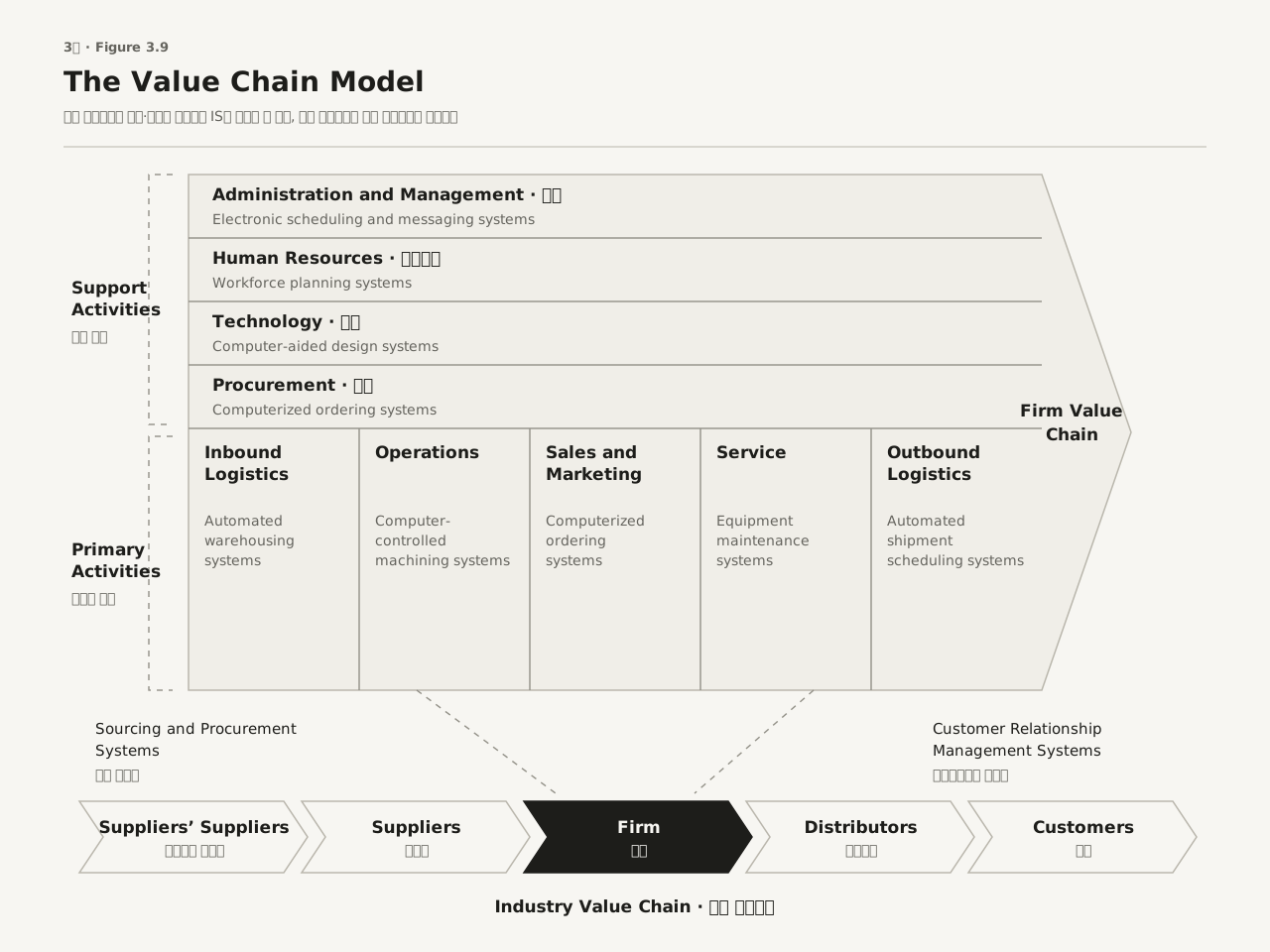
Figure 3.9 · The Value Chain Model — 각 활동에 적용할 수 있는 정보시스템의 예와 산업 가치사슬과의 연결.
개념도 · Value Chain 활동의 위계
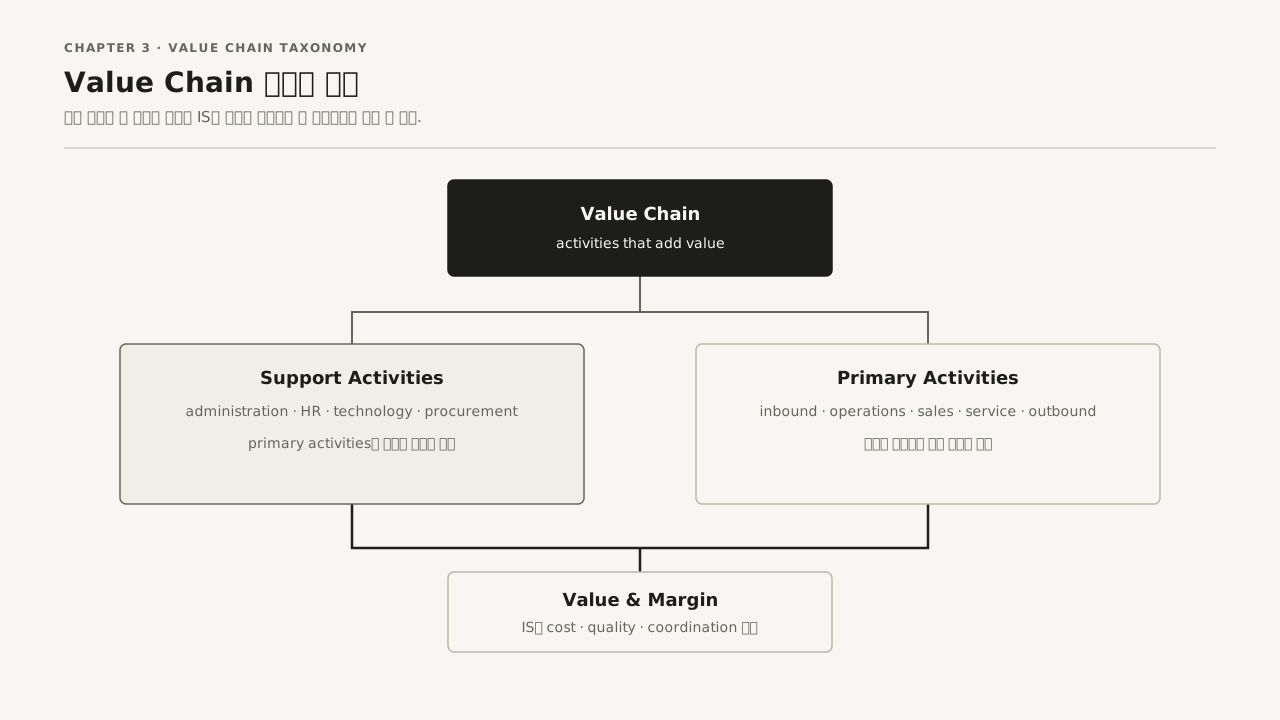
Primary activities는 제품과 서비스를 직접 만들고 전달하며, support activities는 그 활동이 작동할 기반을 제공한다. 두 범주를 구분해야 IS의 적용 지점을 구체적으로 설명할 수 있다.
Slide 39 — Extending the Value Chain: Value Web
Value Chain Extension
- firm value chain은
- suppliers
- distributors
- customers 의 value chains와 연결
Value Web
- independent firms가 synchronized IT를 이용해 value chains 조정
- collectively product / service 생산
- traditional value chain보다
- less linear
- more customer-driven
- more flexible
Value Web = 여러 독립 기업의 value chains를 IT로 연결한 network
교수님 메모: 인터넷 기술이 value web이라는 고도로 동기화된 산업 가치사슬을 가능하게 했다. Value web은 개별 기업의 경계를 넘어 여러 독립 기업의 가치사슬을 조정하며, 수요·공급과 시장 상황 변화에 유연하게 적응한다.
Slide 40 — Figure 3.10 The Value Web
Central Firm 연결
- Suppliers
- Customers
- Strategic Alliances / Partner Firms
- Indirect Suppliers
Supporting Systems
- ERP
- Supply Chain Management Systems
- Customer Relationship Management Systems
- Supplier Extranets
- Net Marketplaces
Value Web는 networked partners를 연결해 supply / demand 변화에 빠르게 대응
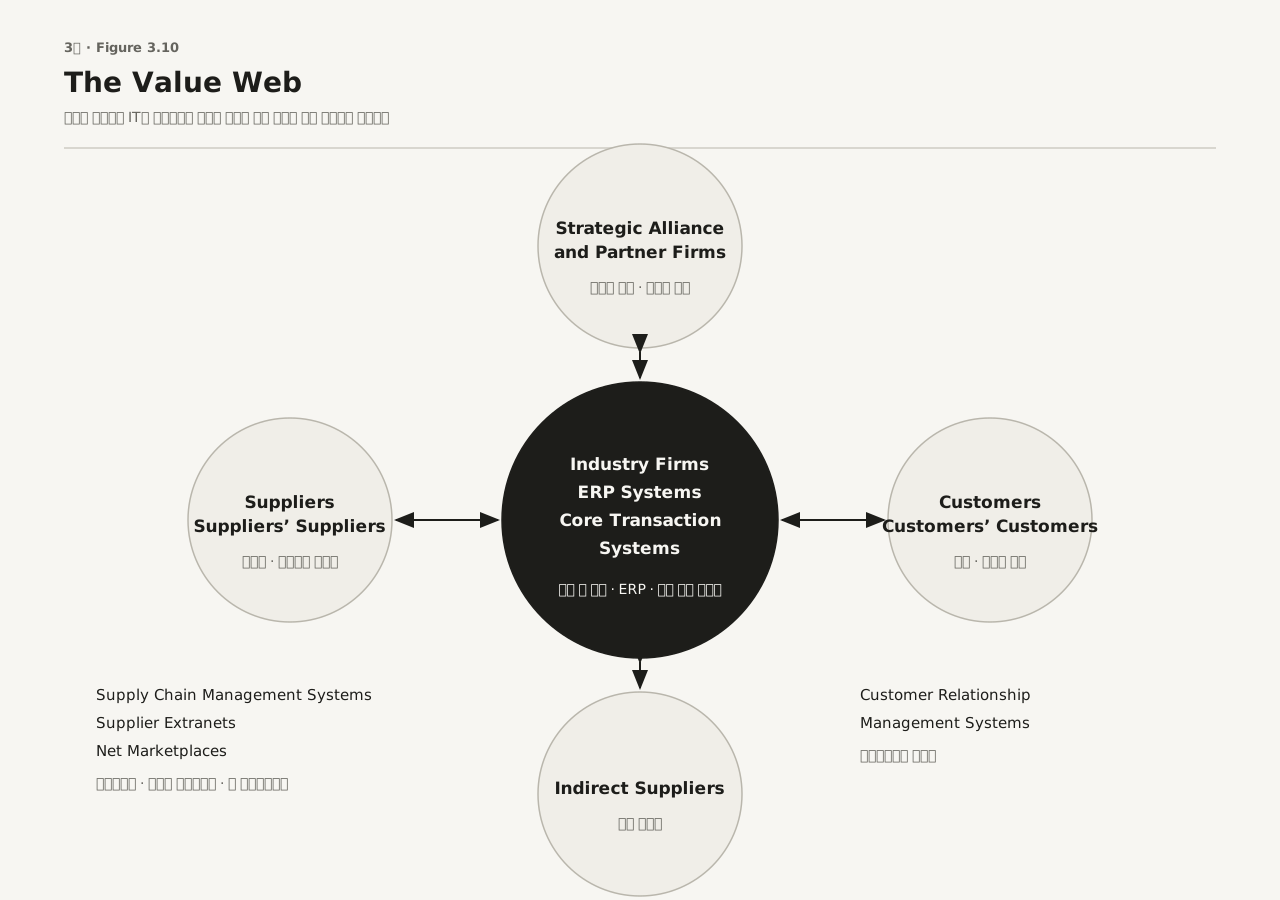
Figure 3.10 · The Value Web — 독립 기업들이 IT로 가치사슬을 연결한 네트워크.
Slide 41 — Synergies
Synergy
- 한 business unit의 output이 다른 unit의 input으로 사용
- 또는 두 organizations가 market / expertise 공유
Result
- cost 감소
- profit 증가
- efficiency 향상
IT Role
- 서로 다른 business units의 operations 연결
Synergy = 1 + 1 > 2가 되도록 business units를 IT로 연결
Slide 42 — Core Competencies
Core Competency
- firm이 world-class leader인 핵심 activity
기반
- knowledge
- experience
- business units 간 knowledge sharing
Examples
- Google → search
- Microsoft → office productivity software
- Intel → processors
- P&G → expert directory / intranet
Core Competency = 경쟁사가 쉽게 따라하기 어려운 world-class capability
Slide 43 — Network-Based Strategies
Network-Based Strategy
- firms가 서로 network할 수 있는 능력을 competitive advantage로 활용
Three Types
- Network Economics
- Virtual Company Model
- Business Ecosystems
Network strategy = firm 내부 자원뿐 아니라 network 전체의 value를 활용
교수님 메모 · 예: Facebook과 eBay는 수백만 사용자의 네트워크에 기반한 기업이다. 웹과 인터넷 통신 도구로 커뮤니티를 만들었고, 더 많은 사람이 가입할수록 회원이 얻는 이익이 커진다.
Slide 44 — Network Economics
핵심
- new participant 추가의 marginal cost ≈ 0
- participant 증가에 따른 marginal gain은 큼
- community size가 커질수록 value 증가
- installed customer base가 커질수록 software value 증가
Traditional Economics와 비교
| Traditional Economics | Network Economics |
|---|---|
| Diminishing Returns | network size 증가 시 value 증가 가능 |
| input 증가 → marginal gain 감소 | participant 증가 → network value 증가 |
Network Economics = 사용자가 많아질수록 network의 value가 커짐
Slide 45 — Virtual Company Model
Virtual Company
- network를 통해 다른 companies와 alliance
- traditional organizational boundary / physical location 제약 없이
- product creation
- distribution 수행
Example: Li & Fung
- garment production / shipment 관리
- 대부분의 work를 수천 suppliers에 outsourcing
Virtual Company = 자산을 직접 소유하기보다 network coordination으로 business 수행
Slide 46 — Business Ecosystems and Platforms
Business Ecosystem
- suppliers / distributors / outsourcing firms / transport / technology firms가 연결된 network
Roles
| Role | 의미 |
|---|---|
| Keystone Firm | ecosystem을 dominate하고 platform 제공 |
| Niche Firm | keystone firm의 platform을 활용해 특정 value 제공 |
Examples
- Microsoft platform
- Walmart systems
Value Web와 차이
- Value Web → 주로 같은 industry의 connected value chains
- Business Ecosystem → multiple industries까지 확장 가능
Ecosystem = platform을 중심으로 여러 firms와 industries가 함께 value를 제공
Network economics는 참여자가 늘어날 때 네트워크 가치가 어떻게 달라지는지를 설명한다. Value Web은 여러 기업의 가치사슬이 어떻게 연결되는지를, Business Ecosystem은 그 연결이 플랫폼을 중심으로 산업 경계까지 넓어지는지를 본다. 세 용어를 같은 뜻으로 외우기보다 각각 가치의 증가·업무 연결·참여 범위 중 무엇에 초점을 두는지 구분하자.
Slide 47 — Figure 3.11 Ecosystem Strategic Model
Ecosystem 내부
- Industry 1
- Industry 2
- Industry 3
- Industry 4
외부 Competitive Forces
- New Market Entrants
- Substitute Products & Services
- Suppliers
- Customers
Key
- digital firm에서는 industry boundaries가 더 dynamic
- competition이 firm 대 firm보다 ecosystem 대 ecosystem 형태로 나타날 수 있음
- IT가 dense interactions를 가능하게 함
Digital era 경쟁 단위는 individual firm에서 ecosystem으로 확장
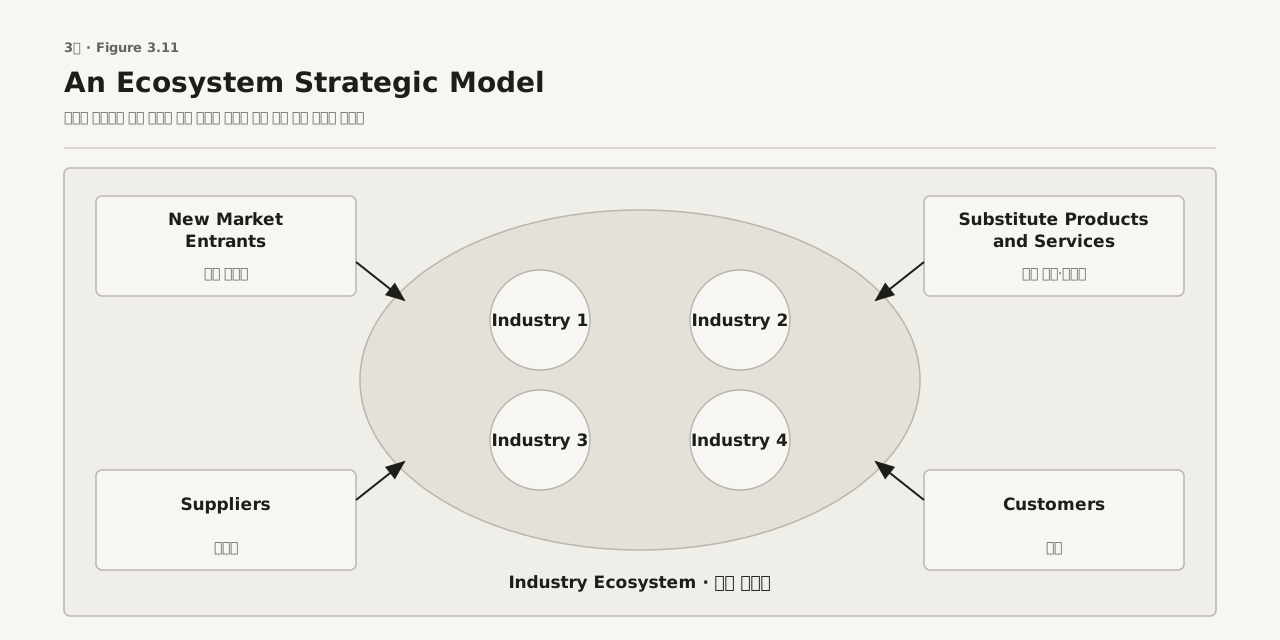
Figure 3.11 · An Ecosystem Strategic Model — 경쟁 단위가 개별 기업에서 생태계로 넓어진다.
Slide 48 — AI in Competitive Strategy
AI and the Value Chain
- Table 3.6에서 value chain 각 activity에 AI가 어떻게 사용되는지 다룸
AI and Porter’s Competitive Forces Model
- Table 3.7에서 AI가 5 Forces 대응 전략에 어떻게 활용되는지 다룸
이 슬라이드는 AI를 Value Chain과 Porter Model에 연결하는 관점을 제시
개념도 · 전략 분석의 세 가지 수준
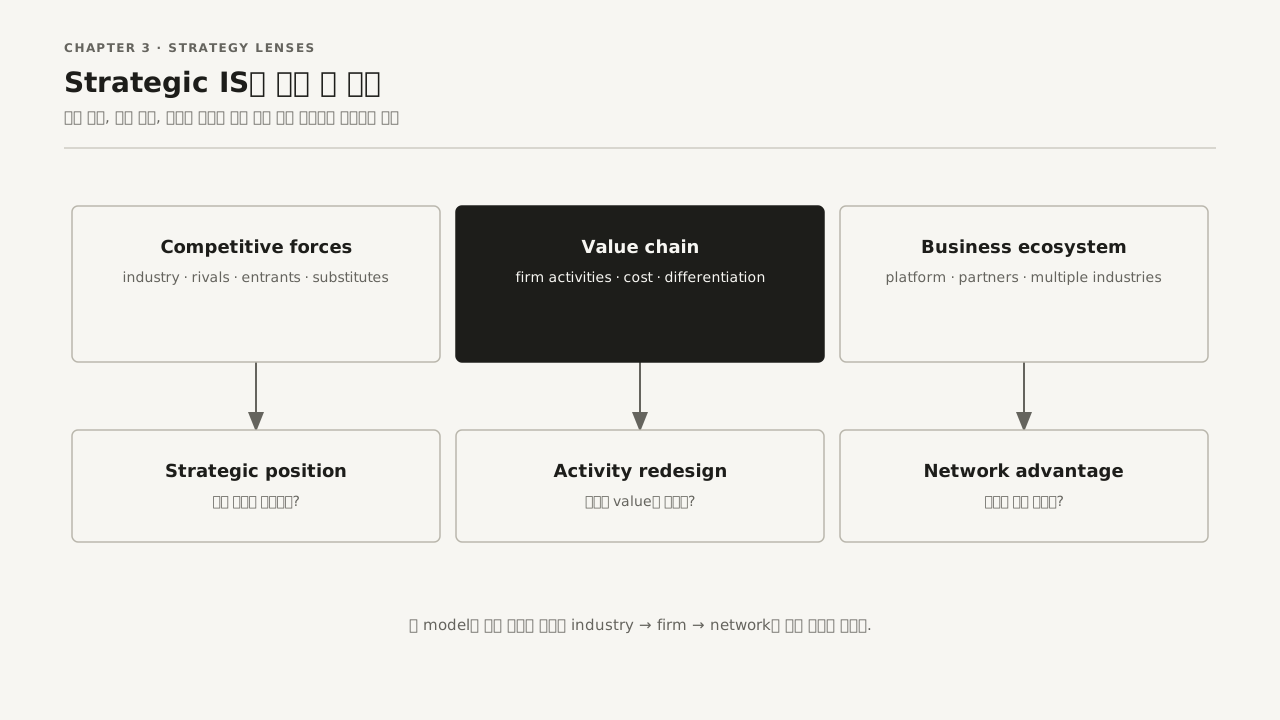
그림 읽기: Porter model은 industry pressure, Value Chain은 firm 내부 activity, Business Ecosystem은 여러 industry와 partner의 network를 본다. 셋은 경쟁하는 이론이 아니라 분석 수준이 다른 도구다.
Slide 49 — Challenges of Strategic Information Systems
1. Sustaining Competitive Advantage
- competitors가 strategic system을 copy / retaliate 가능
- competitive advantage는 항상 sustainable하지 않음
- strategic system이 시간이 지나면 survival tool이 될 수도 있음
2. Aligning IT with Business Objectives
- IT strategy와 business strategy alignment 필요
Strategic Systems Analysis
- industry structure 분석
- firm value chain 분석
- industry value chain 분석
Strategic IS의 핵심 과제 = Advantage를 만들고, 유지하고, business strategy와 정렬하는 것
Slide 50 — Career Relevance
Example
- Company: Crayola
- Position: Business Development Representative
관련 역량
- business understanding
- IT knowledge
- strategy understanding
- market / organization analysis
이 장의 핵심 역량 = Organization + IT + Strategy를 함께 보는 능력
사례 총정리 · 3장에 나오는 기업 예시
시험은 “다음 사례는 어떤 전략·경쟁 요인·개념인가?” 또는 “X의 예를 들라”로 나온다. 기업 → 시스템 → 결과 → 개념을 한 줄로 말할 수 있으면 된다.
| 슬라이드 | 기업·사례 | 시스템·내용 | 핵심 결과·수치 | 연결 개념 |
|---|---|---|---|---|
| 1 | GE (영상) | Industrial Internet | 디지털 기업으로 전환 | IoT, digital firm |
| 1 | NBA × Akamai (영상) | 라이브 스트리밍 글로벌 전송 | — | 인터넷 기반 경쟁 |
| 3 | PepsiCo | Doritos Silent (AI/ML) | crunch 소리 5,000개+ 분석, 게이머 시장 유지·매출 성장 | Customer experience, differentiation |
| 5 | 이메일·메신저 | 15년 전엔 예측 못 함 | — | 조직–IT 관계는 예측 어려움 |
| 10 | 병원(doctor's office) | 접수원·간호사·의사의 루틴 | — | Routines (SOPs) |
| 16 | Google PageRank | 검색의 기반 기술 | — | Disruptive technology |
| 16 | Altair PC, Netscape Navigator | 발명했지만 살아남지 못함 | — | First mover의 실패 |
| 17 | 스타트업 / 중견 제조업 / Fortune 500 / 로펌·학교·병원 / 컨설팅 | Mintzberg(1979) 다섯 구조 | — | Organizational structure |
| 18 | 교도소 / 기업 / 대학 | coercive / utilitarian / normative | — | Organizational goals |
| 22 | Accenture | task force-networked organization | 전문가가 짧게 모였다 흩어짐 | Flattening, postindustrial |
| 26 | 대기업 사내 웹 매뉴얼 | 내부 매뉴얼 웹 배포 | 배포 비용 수백만 달러 절약 | Internet ↓ transaction·agency cost |
| 29 | 컴퓨터 칩 사업 | 높은 진입 장벽 | — | New market entrants |
| 30 | iTunes vs CD | 대체재 | — | Substitute products |
| 33 | Walmart | continuous replenishment = efficient customer response system | 대량 재고 불필요, 낮은 간접비 | Low-cost leadership |
| 33 | Google, Nike, Apple (Uber) | 신제품·경험 | — | Product differentiation |
| 33 | Baume 시계 | 2,160가지 조합 | — | Mass customization |
| 34 | Hilton OnQ (Harrah's), Charlotte Hornets | 고객 데이터 분석 | 좁은 목표 시장 공략 | Focus on market niche |
| 34 | Toyota, Amazon, Starbucks | 공급업체 생산 일정 공유, 추천 | 전환 비용 ↑ | Customer & supplier intimacy |
| 35 | 여행사, 종이 백과사전, 미디어 | 인터넷으로 위협·변화 | 경쟁 심화 | Internet's impact |
| 36 | Under Armour, John Deere | 스마트 제품·센서 | 전환 비용 ↑, 진입 억제 | Smart products, IoT |
| 41 | Bank of NY + JP Morgan Chase, Google + YouTube | 합병·인수 | 비용 ↓, 이익 ↑ | Synergies |
| 42 | P&G (Google 검색, Microsoft 오피스, Intel 프로세서) | 인트라넷 + 전문가 디렉터리 | 세계 최고 수준 활동 | Core competencies |
| 43 | Facebook, eBay | 수백만 사용자 커뮤니티 | 가입자 ↑ → 가치 ↑ | Network-based strategy |
| 45 | Li & Fung | private extranet, 공급업체 1만 5천+ (40개국) | 공장·기계 소유 없음 | Virtual company |
| 46 | Microsoft, Facebook, Walmart | 플랫폼 | keystone vs niche | Business ecosystem |
| 49 | Spotify | AI DJ, Discover Weekly | 팟캐스트 전략은 흔들림 | 경쟁우위 유지의 어려움 |
| 50 | Crayola | iMarker, Google Analytics | 사업모형 전환 | 진로: Business development representative |
3장 사례 — PepsiCo Doritos Silent의 문제·해결·결과는?
다른 사람의 Doritos 씹는 소리가 게이머를 방해하지만 팬들은 바삭함을 좋아함. AI/ML로 5,000개 이상의 crunch 소리를 분석해 배경 소리만 지우는 Doritos Silent 개발. 게이머 시장에서 인기 유지·매출 성장(고객 경험 관리).
3장 사례 — 네 가지 기본 경쟁 전략과 슬라이드 예시 기업은?
Low-cost leadership = Walmart(efficient customer response). Product differentiation = Google, Nike, Apple. Focus on market niche = Hilton Hotels의 OnQ. Customer & supplier intimacy = Toyota, Amazon, Starbucks.
3장 사례 — Walmart의 continuous replenishment system은 어떻게 작동하며 무엇이라고 부르나?
계산대 POS가 바코드를 본사 중앙 시스템으로 보내고, 시스템이 모든 매장의 주문을 모아 공급업체에 바로 전송한다. 소비자 행동을 유통·생산·공급망에 직접 연결하므로 efficient customer response system이다.
3장 사례 — Synergy, core competency, virtual company의 슬라이드 예는?
Synergy = Bank of New York과 JP Morgan Chase 합병, Google의 YouTube 인수. Core competency = P&G의 인트라넷과 전문가 디렉터리(Google 검색, Microsoft 오피스, Intel 프로세서). Virtual company = Li & Fung.
3장 사례 — Li & Fung은 왜 virtual company인가?
공장·원단·기계를 소유하지 않고 40개국 1만 5천 곳 이상의 공급업체에 모든 일을 아웃소싱하며, private extranet으로 주문을 받고 생산 과정을 추적해 GUESS·Levi Strauss 등의 의류를 생산·배송한다.
3장 사례 — disruptive technology를 발명했지만 살아남지 못한 first mover의 예는?
Altair 개인용 컴퓨터, Netscape Navigator 브라우저. (Google 검색의 기반 기술은 PageRank.)
3장 사례 — Mintzberg 다섯 구조와 예시 조직은?
Entrepreneurial = 소규모 스타트업, Machine bureaucracy = 중견 제조업체, Divisionalized bureaucracy = Fortune 500 기업, Professional bureaucracy = 로펌·학교·병원, Adhocracy = 컨설팅사.
3장 사례 — 조직 목표의 세 유형과 짝이 되는 조직은?
Coercive = 교도소, Utilitarian = 기업, Normative = 대학.
3장 사례 — Business ecosystem의 슬라이드 예와 value web과의 차이는?
Microsoft 플랫폼, Facebook, Walmart의 주문·재고 관리 시스템. Ecosystem은 여러 산업에 걸치고, value web은 같은 산업 안 기업들의 가치사슬 연결이다.
단원 마무리
한 쪽 핵심 요약
| 주제 | 꼭 기억할 것 |
|---|---|
| 조직의 정의 | Technical(입력→생산→출력)과 Behavioral(권리·가치·사람)은 보완 관계 |
| 조직의 특징 | Routine → Process → Firm, 정치·문화는 변화를 막을 수 있음 |
| 조직 구조 | Entrepreneurial · Machine bureaucracy · Divisionalized · Professional · Adhocracy |
| IT의 경제적 영향 | Transaction cost ↓ → 외주 ↑·축소 / Agency cost ↓ → 적은 관리자로 확장 |
| 조직 변화 | Flattening, span of control ↑, 저항 = 기술·사람·구조·업무를 동시에 조정 |
| 경쟁 전략 | 다섯 힘(경쟁자·진입자·대체재·고객·공급자) → 네 전략(저원가·차별화·틈새·친밀성) |
| 가치사슬 | Primary 5 + Support 4, Porter는 산업 수준·가치사슬은 기업 수준 |
| 네트워크 전략 | Network economics · Virtual company · Business ecosystem(keystone / niche) |
빈칸 채우기
- 조직과 IT의 관계는 이며, 그 사이를 여러 이 조정한다.
- 여러 루틴이 모여 가 되고, 프로세스가 모여 이 된다.
- IT가 시장 거래 비용을 낮추면 기업은 를 늘리고 규모가 수 있다.
- 관리자 한 명이 관리하는 직원 수를 이라 한다.
- 고객이 다른 회사로 옮기기 어렵게 만드는 비용을 라 한다.
- 가치사슬의 조달(procurement)은 에 속한다.
단답형 연습 · Short Answer
Write the term or a short answer in English. 답은 맨 끝 정답과 해설의 단답형 정답에서 확인한다.
- What do we call the precise rules, procedures, and practices an organization develops to cope with almost all expected situations?
Answer: ______________________________ - Which theory says that firms seek to economize on the costs of participating in markets, such as finding suppliers and managing contracts?
Answer: ______________________________ - What is the number of employees that a single manager supervises called?
Answer: ______________________________ - Name the five basic kinds of organizational structure.
Answer: ______________________________ - What term describes technologies that cause sweeping changes in businesses, industries, and markets?
Answer: ______________________________ - What is the cost a customer incurs when changing from one product or supplier to a competing one?
Answer: ______________________________ - What is the use of mass production resources to deliver products tailored to individual customers called?
Answer: ______________________________ - What do we call a collection of independent firms that use IT to coordinate their value chains to produce a product or service collectively?
Answer: ______________________________ - In a business ecosystem, what kind of firm dominates the ecosystem and creates the platform used by other firms?
Answer: ______________________________ - Which economic concept holds that the marginal cost of adding another participant is about zero while the marginal gain is large?
Answer: ______________________________
개념 회상과 오개념 점검
조직과 information technology의 관계가 양방향이라고 하는 이유를 한 가지씩 설명하시오.
정답 확인
조직의 structure, business process, culture, politics가 어떤 IT를 어떻게 도입할지 결정한다. 반대로 IT는 업무 방식, coordination, 의사결정 권한과 조직 구조를 바꿀 수 있다.
transaction cost theory와 agency theory가 각각 IT의 조직 축소 효과를 어떻게 설명하는지 비교하시오.
정답 확인
transaction cost theory는 시장 탐색·계약·조정 비용이 낮아져 외부 거래를 더 활용할 수 있다고 본다. agency theory는 정보 획득과 감시 비용이 낮아져 적은 관리자도 더 많은 구성원을 관리할 수 있다고 본다.
Porter’s Competitive Forces Model과 Value Chain Model은 분석 질문이 어떻게 다른가?
정답 확인
Porter model은 industry 수준에서 경쟁 압력과 전략적 위치를 본다. Value Chain은 firm 내부와 연결 활동 중 어디에서 value를 더하거나 cost를 줄일지 찾는다.
A company uses a shared digital platform to reduce the cost of finding suppliers and coordinating contracts. Which explanation fits best?
- A. Agency theory
- B. Transaction cost theory
- C. Organizational culture only
- D. Product differentiation only
정답 확인
정답은 B이다. A는 내부의 monitoring cost와 외부 거래 비용을 혼동한 선택이다. C는 technology의 경제적 효과를 culture 하나로만 설명한 선택이다. D는 supplier search와 contract coordination 문제를 product uniqueness 문제로 바꾼 선택이다.
정답과 해설
먼저 스스로 답을 쓴 뒤 확인한다.
확인 문제 정답
- Technical definition은 조직을 자본·노동을 받아 제품을 만드는 생산 구조로, behavioral definition은 권리·의무·가치가 갈등을 거쳐 균형을 이룬 사회 시스템으로 본다.
- Routine → Business process → Firm. 루틴이 모여 프로세스, 프로세스가 모여 기업이 된다.
- Professional bureaucracy. 전문가의 지식과 판단에 의존하는 조직이다.
- Transaction cost theory. 외부 거래가 싸지므로 외주가 늘고 기업 규모는 작아질 수 있다.
- 정보가 아래로 직접 전달되어 중간 관리 단계가 줄어들기 때문에, 관리자 한 명이 더 많은 직원을 감독할 수 있다.
- Information technology, people, organizational structure, job tasks.
- Traditional competitors, new market entrants, substitute products and services, customers, suppliers.
- Customer and supplier intimacy. 관계를 깊게 만들어 전환 비용을 높인다.
- 경쟁 요인은 여전히 작동하지만, 보편적 표준으로 진입이 쉬워지고 가격 비교가 쉬워져 경쟁이 더 치열해졌다.
- Administration and management, human resources, technology, procurement.
- Value web은 주로 한 산업 안의 기업 가치사슬을 연결하고, business ecosystem은 플랫폼을 중심으로 여러 산업에 걸친 더 넓은 네트워크다.
- 거의 0. 참여자를 더하는 비용은 거의 들지 않지만 네트워크 가치는 커진다.
단답형 정답
- Routines (standard operating procedures, SOPs) — 예상되는 상황에 대응하도록 정해 둔 정확한 규칙·절차·관행
- Transaction cost theory — 시장 참여 비용을 줄이려는 관점. IT가 이 비용을 낮추면 외주가 늘어난다
- Span of control — 관리자 한 명이 관리하는 직원 수. IT로 넓어진다
- Entrepreneurial structure, machine bureaucracy, divisionalized bureaucracy, professional bureaucracy, adhocracy — 창업형, 기계적 관료제, 사업부형 관료제, 전문적 관료제, 애드호크라시
- Disruptive technologies — 산업과 시장을 크게 바꾸는 파괴적 기술
- Switching cost — 다른 제품·공급자로 바꿀 때 드는 전환 비용
- Mass customization — 대량생산 자원으로 개인 맞춤 제품을 제공하는 것. 제품 차별화의 한 방법
- Value web — IT로 가치사슬을 연결한 독립 기업들의 네트워크
- Keystone firm — 생태계를 지배하고 플랫폼을 제공하는 핵심 기업
- Network economics — 참여자가 늘수록 네트워크 가치가 커지는 네트워크 경제
내용을 이해했다면 학습 완료를 체크해 주세요.