2장 B · 협업에서 조직 지식과 IS 기능까지
이번 강의에서 배울 것
- 협업 성과를 만드는 문화·프로세스·도구의 조건을 설명한다.
- 지식관리 가치사슬과 주요 KMS 유형을 구분한다.
- IS 부서·IT 거버넌스·책임 있는 AI의 역할을 연결한다.
학습 경로
범위: Chapter 2 슬라이드 30–73 · Collaboration → Knowledge → IS Function
Chapter 2 원본 PDF · Chapter 2 확장 PDF
단원 도입
| 출제 포인트 | 빈도 | 이렇게 나온다 |
|---|---|---|
| 지식관리 가치사슬 4단계 | ★★★ | 순서, 막힌 단계 찾기 |
| Tacit vs Explicit knowledge | ★★★ | 사례 분류 |
| KMS 세 유형(전사 KMS · KWS · 지능형 기법) | ★★★ | 사례에 맞는 유형 고르기 |
| 시간·공간 협업 매트릭스 | ★★ | 도구를 칸에 넣기 |
| 협업의 요건, social business | ★★ | 기술만으로 안 되는 이유 |
| IS 부서 · systems analyst · IT governance | ★★ | 역할과 정의 |
책 읽는 법: 슬라이드 제목 아래의 짧은 목록과 요약 한 줄이 강의 핵심 필기다. 개념은 정의, 판서는 한눈 정리, 해설은 쉬운 설명, 오답 주의는 시험 함정, 예제는 풀이 연습, 확인 문제의 답은 단원 끝 정답과 해설에 있다.
형광펜 읽는 법: 노랑 핵심 정의·결론 · 빨강 시험에서 헷갈리는 구분·함정 · 파랑 외워야 할 순서·목록
PART 1 · 협업과 소셜 비즈니스
Slide 30 — What Is Collaboration?
- collaboration은
- short-term / long-term
- informal / formal(team)
Importance가 커진 이유
- changing nature of work
- professional interaction jobs 증가
- firm organization 변화
- firm scope 변화
- innovation 강조
- work culture 변화
현대 업무는 개인 작업보다 interaction과 collaboration 비중이 커짐
예시 박스 읽는 법: 예시 박스는 슬라이드의 실제 사례·수치와 교수님 메모를 교재로 보충한 것이다. 기업 → 시스템 → 결과 → 개념을 함께 외운다. 장 끝 사례 총정리에 한 표로 모았다.
Slide 31 — What Is Social Business?
- internal / external social networking platforms 활용
- employees / customers / suppliers engagement
- interaction 심화 + information sharing 가속
- customer와의 conversation 강화
- information transparency 필요
Expected Benefits
- operational efficiency
- innovation
- faster decision making
Social Business = social platform을 business interaction과 information sharing에 활용
Slide 32 — Collaboration Is Expanding to Human-Agent Teams
- collaboration 범위가 people + AI agents로 확대
- effective teams는 AI 사용법 / mistakes / quality standards를 공유
- agent workflow를 문서화
- human handoff
- review criteria
- authority
Management
- people
- data
- applications
- AI agents 를 함께 coordinate
Human-Agent Team의 핵심 = workflow + handoff + review + authority를 명확히 정의
Slide 33 — Business Benefits of Collaboration and Teamwork
| Benefit | 효과 |
|---|---|
| Productivity | knowledge sharing / faster problem solving |
| Quality | quality issue 신속 해결 |
| Innovation | product / service ideas 증가 |
| Customer Service | complaints 빠르게 처리 |
| Financial Performance | 위 개선이 재무성과로 연결 |
Collaboration은 productivity / quality / innovation / service를 통해 firm performance에 영향
슬라이드·교수님 메모: 협업 기술 투자는 특히 영업·마케팅, 연구개발(R&D)에서 큰 보상을 낸다. 협업의 효과에 대한 연구는 일화적(anecdotal)이지만, 업계와 학계는 협업을 성공의 필수 동력으로 본다: “더 많이 협업하는 기업이 더 많이 번다.”
Slide 34 — Figure 2.7 Requirements for Collaboration
Collaboration Capability
- open culture
- decentralized structure
- breadth of collaboration
Collaboration Technology
- implementation / operations 지원
- strategic planning 지원
↓
Collaboration Quality
↓
Firm Performance
좋은 collaboration = 적절한 organizational culture/structure + technology
협업 도구는 대화를 전달할 통로를 제공하지만, 누구의 의견을 받아들이고 어떤 정보를 공유할지는 팀의 일하는 방식이 결정한다. 따라서 협업 성과가 낮을 때는 도구의 기능 부족과 의견을 말하거나 활용하기 어려운 조직 조건을 나누어 살펴봐야 한다.
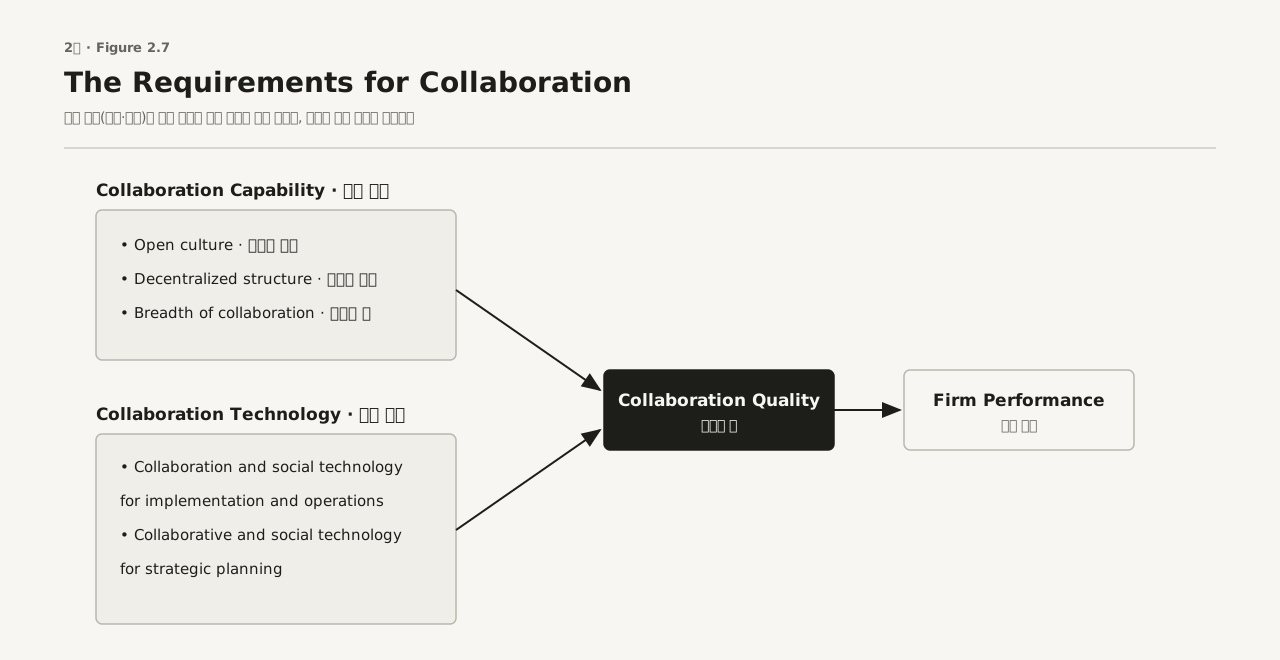
Figure 2.7 · The Requirements for Collaboration — 역량과 기술이 함께 있어야 협업의 질이 높아진다.
교수님 메모: 두 핵심 재료는 협업 역량(collaboration capability)과 협업 기술(technology or means)이며, 둘의 질이 높을수록 기업 성과가 좋다. 저품질 협업의 예: 사업 문제를 풀려고 팀을 꾸렸지만 내부 정치(internal politics) 때문에 함께 일하지 못하는 경우.
Slide 35 — Digital Infrastructure Has an Environmental Footprint
Business Issue
- AI / cloud → data-center computing, electricity, cooling, water, hardware 수요 증가
Evaluation Point
- energy
- carbon
- water
- hardware
- supply-chain impacts
Efficiency
- cleaner energy + more efficient hardware 중요
Digital investment는 service value뿐 아니라 environmental cost도 함께 평가
Slide 36 — Building a Collaborative Culture and Business Processes
과거: Command and Control
- teamwork / lower-level participation 가치 낮음
Collaborative Business Culture
- senior managers가 teams 활용
- policies / products / designs / processes / systems를 team 기반으로 운영
- manager의 역할 = build teams
Key
- collaboration technology만 도입해도 collaboration이 자동으로 생기지는 않음
- culture / reward / process가 필요
Collaboration은 technology보다 culture와 management design이 선행되어야 함
교수님 메모: 협업은 저절로 생기지 않고 가능하게 만들고 길러야(enabled and nurtured) 한다. 협업 기술이 있어도 협업이 업무의 일부로 여겨지고 보상받지 않으면 협업은 일어나지 않는다. “command and control”은 과거의 대기업 방식이다. 생각해 볼 질문: 협업이 적을수록 이득인 업무가 있을까? 협업의 단점은?
Slide 37 — Tools and Technologies for Collaboration
- E-mail / IM
- Wikis
- Virtual worlds
- Virtual meeting systems / telepresence
- Cloud collaboration
- Google Drive / Docs
- Microsoft Teams / SharePoint
- Slack / Zoom
- Google Workspace
- Notion
- embedded Generative AI assistants
- human direction 아래 task 수행하는 AI agents
Collaboration tools는 messaging → shared workspace → cloud → AI-assisted workflow로 확장
Slide 38 — Enterprise Social Networking Software
Capabilities
- Profiles
- Content sharing
- Feeds / notifications
- Groups / team workspaces
- Tagging / social bookmarking
- Permissions / privacy
Modern Platform 평가 요소
- identity
- information governance
- data location
- integration
- accessibility
- search quality
- AI-generated answer quality
Enterprise social platform = communication + content + workflow + governance + AI
교수님 메모(원본 PDF): Facebook에서 보는 거의 모든 기능이 기업용 소셜 네트워킹 커뮤니티에 다시 만들어져 있다. 단, Facebook에는 팀 작업공간(team workspaces)이 없다. 대표 제품 예: Yammer(Sharp 사례).
Slide 39 — Evaluating Collaboration Tools
Two Dimensions
| Dimension | 구분 |
|---|---|
| Space | remote / co-located |
| Time | synchronous / asynchronous |
Six Steps
| Step | 평가 내용 |
|---|---|
| 1 | collaboration challenges identify |
| 2 | available solutions identify |
| 3 | cost / benefit analyze |
| 4 | security risks evaluate |
| 5 | users에게 implementation / training issue 확인 |
| 6 | vendors evaluate |
Tool 선택은 기능보다 work context + cost + security + users + vendor를 함께 봐야 함
Slide 40 — Current Criteria for Collaboration Platforms
| Criteria | 확인할 내용 |
|---|---|
| Work Fit | synchronous / asynchronous / remote / co-located / cross-company |
| Integration | identity / calendar / documents / enterprise apps / workflow / APIs |
| Governance | ownership / permissions / retention / e-discovery / data location / external sharing |
| AI Quality | grounding / citations / access-aware retrieval / monitoring / human review |
| Adoption | active use / search success / cycle time / quality / employee experience / outcomes |
Collaboration platform 평가는 Work Fit + Integration + Governance + AI Quality + Adoption
Slide 41 — Figure 2.8 Time/Space Collaboration Matrix
| Same Time | Different Time | |
|---|---|---|
| Same Place | Face-to-face interactions | Continuous task |
| Different Place | Remote interactions | Communication + coordination |
Examples
- Same place + same time: meeting / decision room
- Different place + same time: video conference / IM
- Different place + different time: e-mail / blogs / group calendars / workflow / version control
Collaboration technology는 Time × Space 기준으로 분류 가능
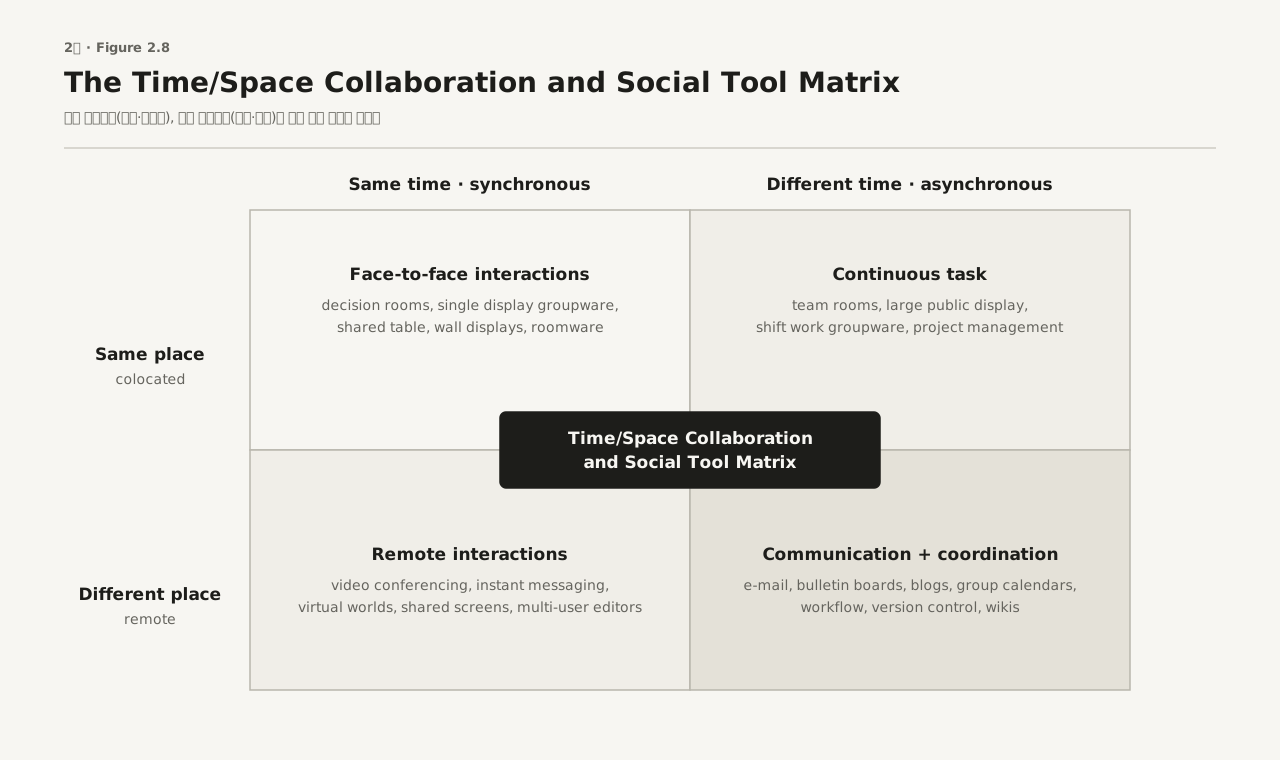
Figure 2.8 · The Time/Space Collaboration and Social Tool Matrix — 시간과 장소로 협업 도구를 나눈다.
PART 2 · 지식관리
Slide 42 — Role of KMS in Business
- KMS는 software investment의 빠르게 성장하는 영역
- knowledge / information workers 비중 큼
- firm value의 상당 부분이 intangible assets와 연결
- knowledge
- brands
- reputation
- unique business processes
- well-executed knowledge project → 높은 ROI 가능
현대 기업의 핵심 자산 중 상당 부분은 physical asset이 아니라 knowledge
Slide 43 — Important Dimensions of Knowledge (1/5)
Core Concepts
- Data / Knowledge / Wisdom
- Tacit Knowledge / Explicit Knowledge
Four Dimensions
- Knowledge is a firm asset
- Knowledge has different forms
- Knowledge has a location
- Knowledge is situational
Knowledge는 단순 정보가 아니라 조직 안에서 형태·위치·상황을 갖는 asset
교수님 메모 · “지식은 기업 자산이다”의 예: 가전제품 회사라면, 가장 효율적이고 가장 싼 에어컨을 만드는 방법을 아는 것. 각 차원마다 예를 들 수 있게 준비한다 — 예: 사회적 기반을 가진 지식의 예는? sticky(옮기기 어려운) 지식의 예와 무엇이 sticky한지?
Slide 44 — Important Dimensions of Knowledge (2/5)
Knowledge Is a Firm Asset
- intangible
- data / information → knowledge 변환에 organizational resources 필요
- 공유될수록 network effects 발생
Explicit vs Tacit Knowledge
| Explicit Knowledge | Tacit Knowledge | |
|---|---|---|
| 형태 | documented | 사람의 mind / experience에 존재 |
| 예 | procedure / manual / report | know-how / craft / skill |
| 전달 | 비교적 쉬움 | 문서화·이전이 어려움 |
Explicit = 문서화 가능 / Tacit = 경험과 사람에게 내재된 know-how
슬라이드 원문 · 지식의 형태: know-how, craft, skill / how to follow procedure(절차를 따르는 법) / knowing why things happen(인과관계, causality).
Slide 45 — Important Dimensions of Knowledge (3/5)
Knowledge Has a Location
- cognitive event
- individual + social
- sticky: 이동하기 어려움
- situated: firm culture에 얽혀 있음
- contextual: 특정 context에서만 작동 가능
Knowledge Is Situational
- Conditional: 언제 procedure를 적용할지 앎
- Contextual: 어떤 상황에서 tool을 쓸지 앎
Knowledge는 context에서 분리하면 그대로 이전되지 않는 경우가 많음
매뉴얼은 절차를 기록할 수 있어도 숙련자가 언제 그 절차를 적용하거나 예외로 처리하는지까지 모두 담기는 어렵다. 그래서 tacit knowledge를 다룰 때는 문서를 늘리는 것뿐 아니라 경험을 가진 사람과 연결하고 적용 상황을 함께 전달하는 방법이 필요하다.
Slide 46 — Important Dimensions of Knowledge (4/5)
- information → knowledge 변환에는
- patterns
- rules
- context 발견이 필요
Wisdom
- knowledge를 실제 문제에 적용한 collective / individual experience
- where / when / how to apply knowledge
Knowledge-Based Core Competencies
- competitors가 쉽게 duplicate하지 못하는 know-how
- profit / competitive advantage의 원천
- 슬라이드 예: 독특한 주문생산(build-to-order) 생산 시스템을 갖는 것
Information + context/pattern → Knowledge → 경험을 통한 적용 = Wisdom
개념도 · Data에서 Wisdom까지의 위계
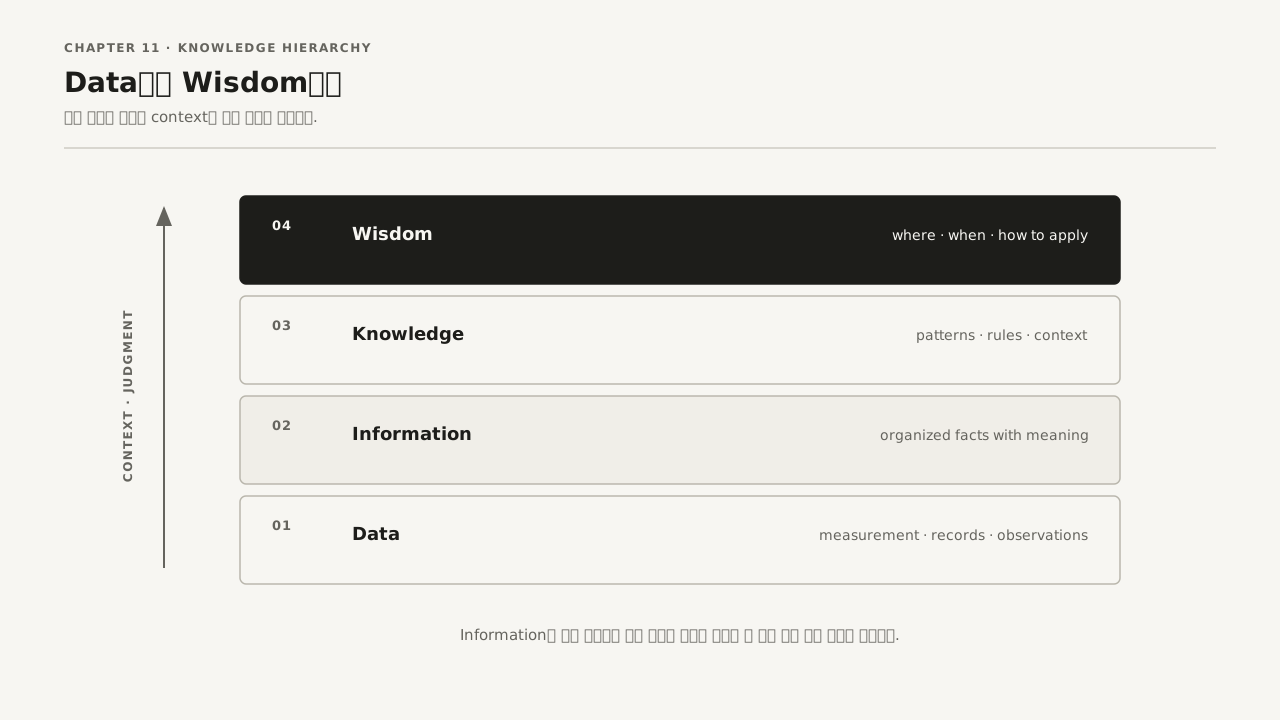
이 위계에서 위 단계는 아래 단계를 없애는 것이 아니라 해석과 판단을 추가한다. 따라서 data를 많이 모았다는 사실만으로 knowledge나 wisdom이 자동으로 생기지는 않는다.
Slide 47 — Important Dimensions of Knowledge (5/5)
Organizational Learning
- data collection / measurement / trial and error / feedback로 experience 획득
- experience에 맞게 behavior 조정
- 결과
- new business processes
- changed management decision patterns
Organizational Learning = 경험을 수집하고 행동과 process를 실제로 바꾸는 과정
Slide 48 — Knowledge Management Value Chain (1/3)
Knowledge Management
- knowledge를 create / store / transfer / apply하기 위한 business processes
Value Chain
| Stage | 의미 |
|---|---|
| 1. Acquisition | knowledge를 획득·생성 |
| 2. Storage | knowledge를 저장·관리 |
| 3. Dissemination | 필요한 사람에게 전달 |
| 4. Application | decision / process에 실제 적용 |
- 각 stage가 raw data / information에 value 추가
KM Value Chain = Acquire → Store → Disseminate → Apply
Slide 49 — Generative AI in the KM Value Chain
| Stage | GenAI 활용 | 관리 포인트 |
|---|---|---|
| Acquire | transcription / extraction / classification | meetings / documents를 searchable knowledge로 변환 |
| Store | knowledge base 관리 | metadata / ownership / permissions / retention / provenance |
| Disseminate | enterprise search / RAG | approved source와 question 연결 |
| Apply | decision / action 지원 | human review / authority / monitoring / escalation |
GenAI도 KM Value Chain 안에서 Acquire → Store → Retrieve → Apply 구조로 관리
Slide 50 — Figure 11.1 Knowledge Management Value Chain
Data & Information Acquisition
- collection / storing / disseminating
Information System Activities
- Acquire: business analytics / data mining / ML / expert networks
- Store: content management / knowledge databases / expert systems
- Disseminate: portals / search / collaboration tools
- Apply: DSS / enterprise apps / robotics
Management & Organizational Activities
- knowledge culture
- communities of practice
- organizational routines / culture
- training / collaboration
- new process / products / services / markets
Feedback
- application 결과가 다시 data / knowledge acquisition으로 연결
KM은 IT activity만이 아니라 management / organization activity가 함께 있어야 완성
교재 그림 · Figure 11.1
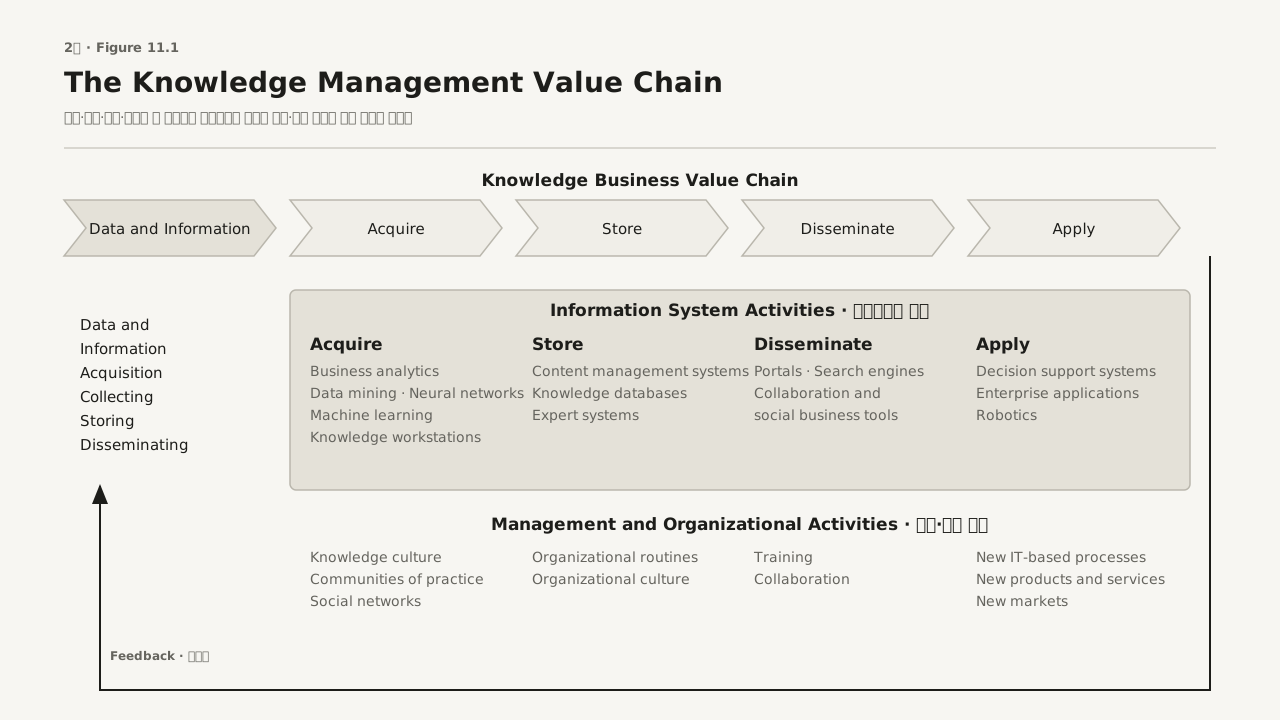
Figure 11.1 · The Knowledge Management Value Chain — 각 단계에 IS 활동과 경영·조직 활동이 함께 있다.
슬라이드 메모: 오늘날의 지식관리는 정보시스템 활동 + 그것을 가능하게 하는 수많은 경영·조직 활동으로 이루어진다. 그림 옆 판서 “80:20”은 지식관리에서 기술보다 경영·조직 쪽 비중이 훨씬 크다는 뜻으로 읽는다(정확한 의미는 수업 필기로 확인). 그림의 두 추가 요건: 지식의 기반이 되는 초기 데이터·정보 획득, 적용 단계에서 새 기회로 이어지는 피드백.
개념도 · 지식이 조직 성과가 되는 과정
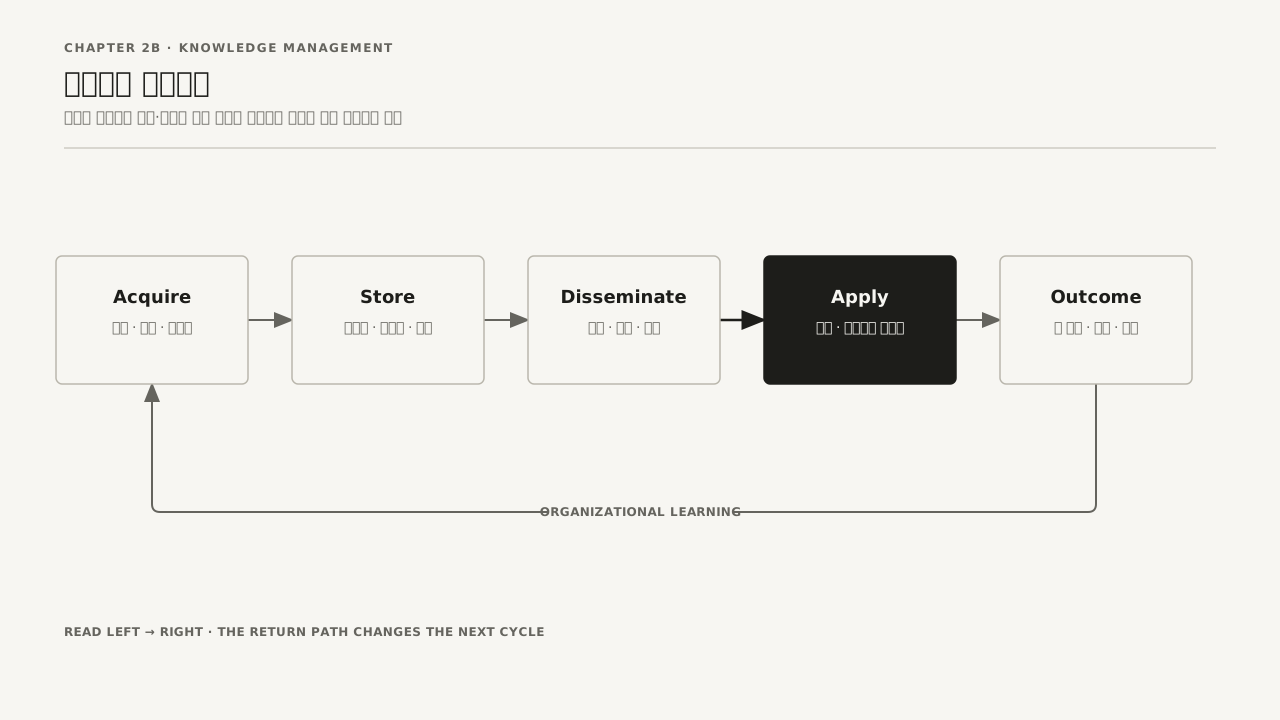
그림 읽기: 지식을 많이 저장하는 것만으로는 가치가 생기지 않는다. 필요한 사람에게 전달된 지식이 의사결정과 프로세스에 적용(Application)되어야 새 업무·제품·시장이 만들어진다. 그 결과를 다시 획득 단계로 돌려 기준과 행동을 바꾸는 것이 조직 학습(Organizational Learning)이다.
Slide 51 — Knowledge Management Value Chain (2/3)
Knowledge Acquisition
- tacit / explicit knowledge document화
- reports / presentations / best practices 저장
- e-mails 같은 unstructured documents 저장
- expert networks 구축
- new knowledge creation
- TPS / external sources data tracking
Knowledge Storage
- databases
- document management systems
Management Role
- planned storage system 지원
- corporate-wide schema / indexing 설계
- employees가 문서를 update / store하도록 incentive 제공
Acquire는 지식을 모으는 단계 / Store는 구조화·관리 가능한 형태로 보존하는 단계
슬라이드 메모: Schema: 지식의 추상적 구조(abstract structure of knowledge). 경영진의 세 역할: ① 계획된 지식 저장 시스템 개발 지원 ② 전사적 문서 색인 스키마 개발 장려 ③ 문서를 제대로 갱신·저장하는 데 시간을 쓴 직원에게 보상.
Slide 52 — Knowledge Management Value Chain (3/3)
Knowledge Dissemination
- portals / wikis
- e-mail / IM
- search engines
- collaboration tools
Information Overload 대응
- training
- informal networks
- shared management experience
Knowledge Application
- ROI를 내려면 knowledge가 실제 decision making에 들어가야 함
- DSS / management process에 embed
- 결과
- new business practices
- new products / services
- new markets
Knowledge는 전달만 해서는 가치가 없고 실제 decision / process에 적용되어야 함
네 단계는 각각 다른 질문에 답한다. ‘자료가 있는가’는 획득·저장, ‘필요한 사람이 찾을 수 있는가’는 전달, ‘찾은 내용을 실제 결정에 썼는가’는 적용의 문제다. 보고서가 많아도 업무가 바뀌지 않았다면 어느 단계에서 흐름이 끊겼는지 이 순서로 확인한다.
Slide 53 — Collaboration, Communities of Practice, Office Environments
New Organizational Roles
- CKO (Chief Knowledge Officer)
- knowledge managers / dedicated staff
Communities of Practice (COPs)
- professionals / employees의 informal social networks
- education
- newsletters
- knowledge sharing
- new employee learning curve 감소
COP = 같은 전문영역 사람들이 경험과 know-how를 지속적으로 공유하는 network
교재 보충 (p.455 표시): CKO(chief knowledge officer)는 기업의 지식관리 프로그램을 책임지는 임원으로, 새로운 지식 원천을 찾거나 기존 지식을 조직·경영 프로세스에 더 잘 쓰도록 프로그램과 시스템을 설계한다. COP 활동 예: 교육, 온라인 뉴스레터, 지식 공유.
Slide 54 — Three Major Types of KMS
| Type | 대상 / 목적 |
|---|---|
| Enterprise-Wide KMS | firm-wide knowledge의 collection / storage / distribution / application |
| Knowledge Work Systems (KWS) | engineers / scientists 등 knowledge workers의 new knowledge 생성 |
| Intelligent Techniques | data mining 등으로 knowledge discovery / optimal solution 탐색 |
KMS 3종류 = Enterprise-wide KMS / KWS / Intelligent Techniques
교수님 메모: 세 범주는 지원 대상(constituencies), 사용 목적, 강조점이 다르다. Intelligent techniques는 흔히 인공지능(AI)이라고 부른다.
Slide 55 — Figure 11.2 Major Types of KMS
Enterprise-Wide KMS
- enterprise content management
- collaboration / social tools
- learning management systems
Knowledge Work Systems
- CAD
- virtual reality
Intelligent Techniques
- data mining
- neural networks
- expert systems
- machine learning
- NLP
- computer vision
- robotics
- genetic algorithms
- intelligent agents
KMS는 조직 전체 지식관리 / 지식 생성 작업 / AI 기반 지식기술로 나뉨
교재 그림 · Figure 11.2
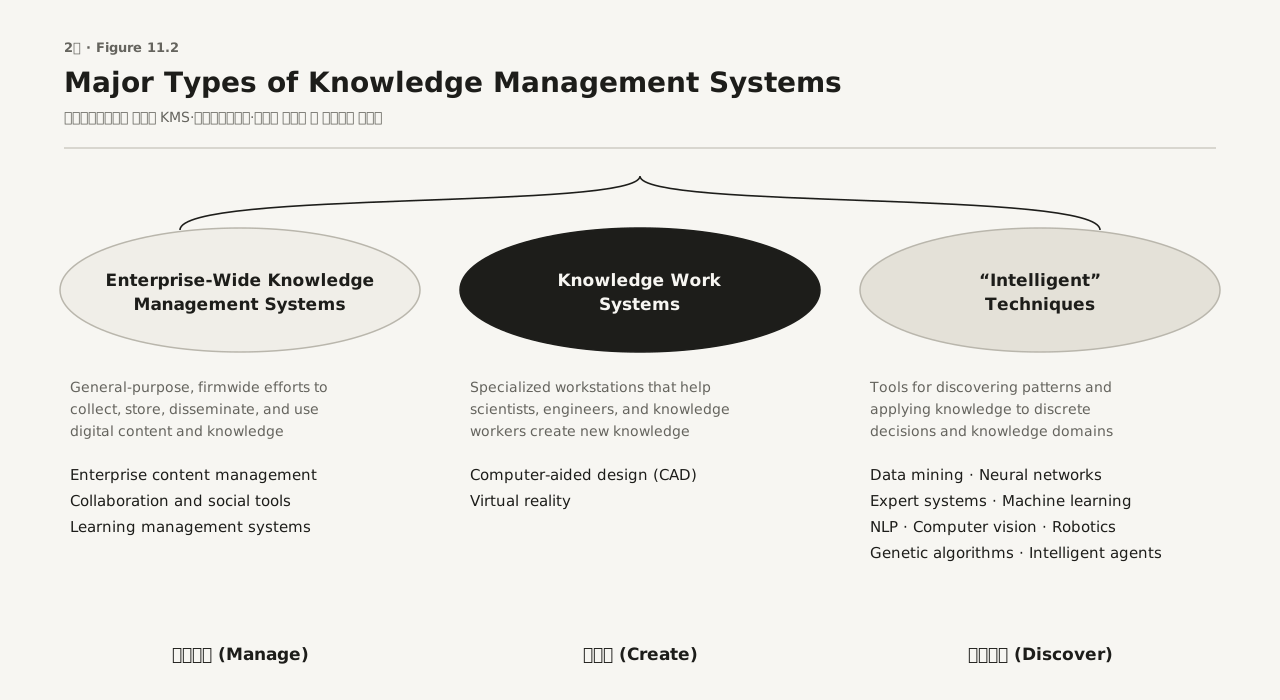
Figure 11.2 · Major Types of Knowledge Management Systems — 관리하기 · 만들기 · 발견하기.
개념도 · KMS 유형을 나누는 기준
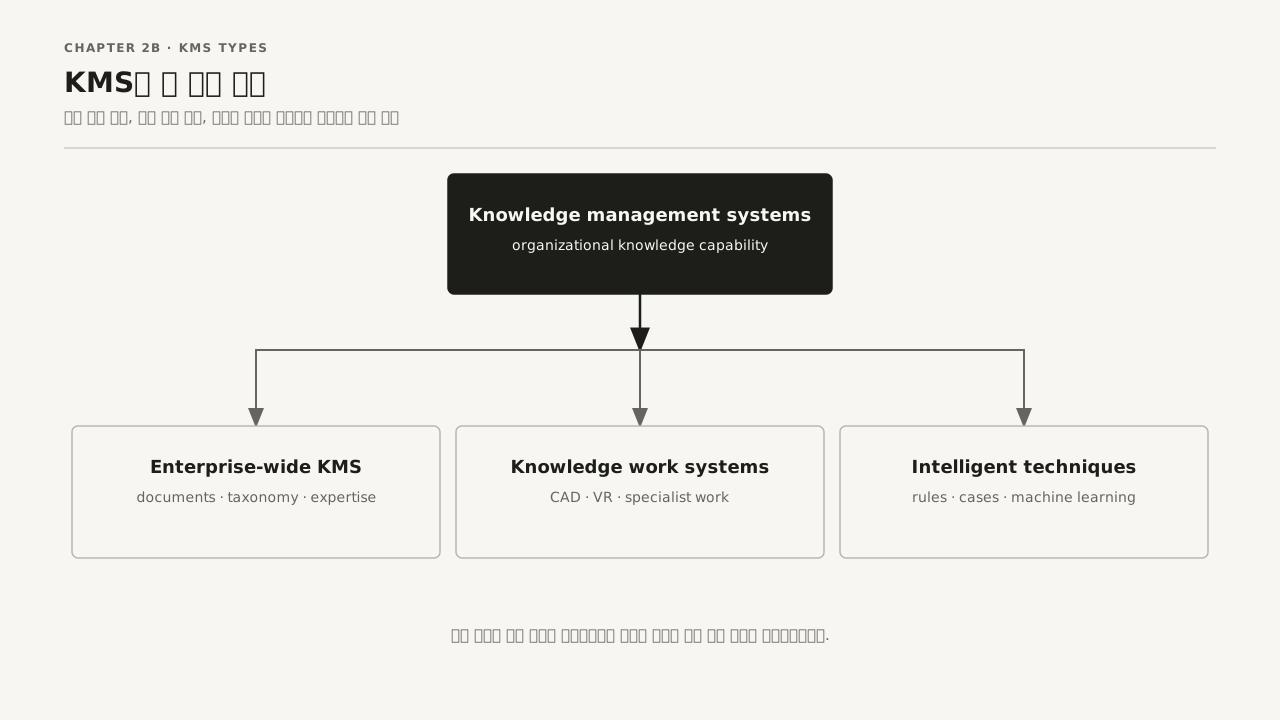
그림 읽기: enterprise-wide KMS는 조직 전체의 지식 공유, KWS는 전문가의 새로운 지식 창출, intelligent techniques는 규칙·사례·data에서 pattern이나 해법을 찾는 데 초점이 있다. 사용 기술보다 지원하는 knowledge activity로 구분한다.
Slide 56 — Enterprise-Wide Knowledge Types
| Type | 예시 | 특징 |
|---|---|---|
| Structured | reports / presentations / formal rules | 형식과 구조가 명확 |
| Semistructured | e-mails / videos | 일부 구조는 있으나 완전히 정형화되지 않음 |
| Unstructured / Tacit | experience / know-how | 사람과 상황에 내재 |
- informal / unstructured knowledge도 business에서 중요
- 비율은 organization마다 다름
기업 지식은 structured + semistructured + tacit/unstructured 모두 관리해야 함
Slide 57 — Enterprise Content Management Systems (CMS)
Purpose
- documents / semistructured knowledge를
- capture
- store
- retrieve
- distribute
- preserve
External Sources
- news feeds / research
Collaboration
- blogs / wikis
Key Problem: Taxonomy
- knowledge object를 category로 tagging해야 retrieval 가능
Digital Asset Management
- photos / graphics / video / audio 등 unstructured digital assets 관리
CMS의 핵심 = content 저장보다 classification / taxonomy / retrieval
교수님 메모: CMS 구축의 첫 단계는 지식 객체(문서)를 나중에 찾을 수 있게 설명하는 것이다. 기업은 사용자에게 의미 있는 범주를 정의하는 taxonomy를 정하고, 지식 객체에 분류를 붙여(tagged) 검색되게 한다. 기업마다 taxonomy가 다를 수 있는 이유도 생각해 볼 것. Digital asset management 시스템이 필요한 기업: 출판사, 광고회사, 로펌, 방송사, 엔터테인먼트 제작사 등.
Slide 58 — AI-Ready Content Management
| Criteria | 핵심 |
|---|---|
| Quality | duplicates 제거 / authoritative version 식별 / obsolete info 수정 |
| Metadata | category / date / sensitivity / business context / retention |
| Access | source와 동일한 permissions / legal restrictions |
| Provenance | source link / creation date / version history / correction path |
| Evaluation | retrieval coverage / accuracy / confidentiality / bias / real-work performance |
AI-ready content = clean + well-labeled + access-controlled + traceable + evaluated
AI가 문서를 검색해 답할 때도 원래 문서의 품질과 접근 권한을 건너뛸 수는 없다. 오래된 판본과 최신 판본을 구분하지 못하면 그럴듯한 답을 잘못된 근거로 만들 수 있고, 권한을 지키지 못하면 찾을 수 있다는 이유만으로 보여서는 안 되는 정보까지 노출될 수 있다.
Slide 59 — Figure 11.8 Enterprise Content Management System
User Actions
- Create / Capture
- Tag
- Store / Retrieve
- Manage / Review
- Distribute / Publish
↓
Unified Repository
- reports / presentations
- best practices
- memos
- graphics / video
- news feeds
- wikis / blogs
- employee profiles
ECM = 다양한 enterprise content를 unified repository에서 분류·관리·배포
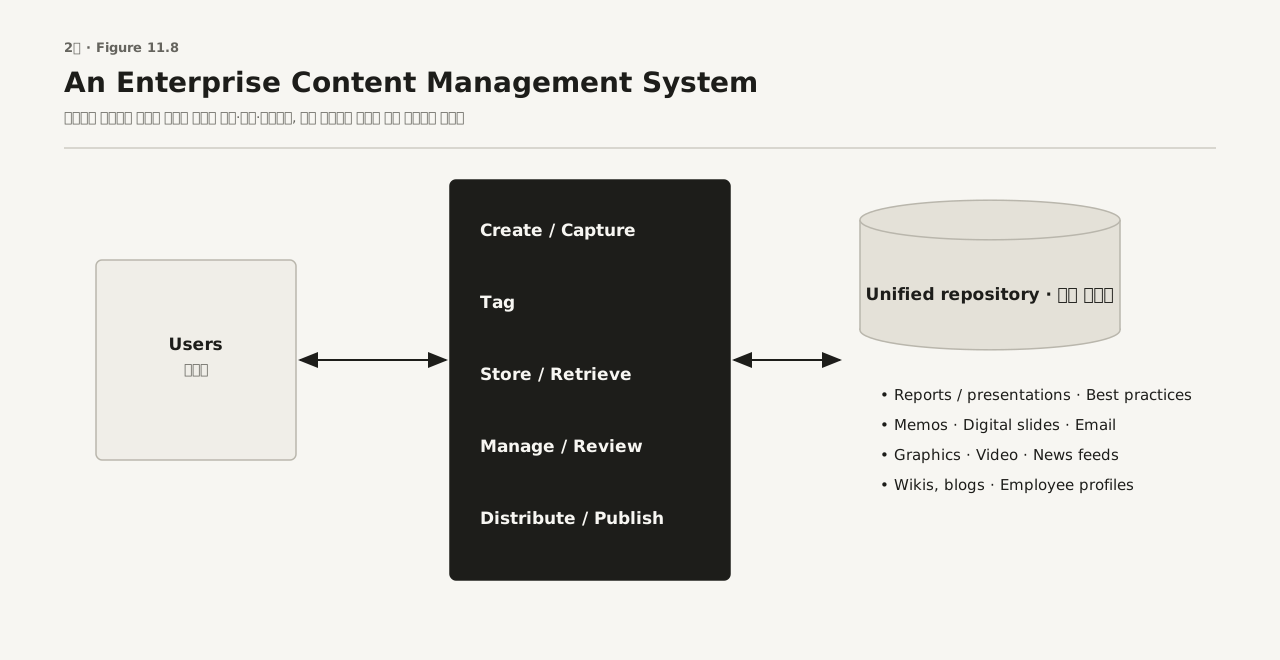
Figure 11.8 · An Enterprise Content Management System — 모든 콘텐츠가 하나의 통합 저장소에 모인다.
Slide 60 — Locating and Sharing Expertise
- well-defined knowledge domain별 corporate expert directory 제공
- search tools로 적절한 expert 찾기
- social networking / social business tools로 external knowledge 탐색
- saving / tagging / sharing web pages
모든 knowledge를 문서화할 수 없으므로 ‘누가 알고 있는지’를 찾는 기능도 중요
Slide 61 — Learning Management Systems (LMS)
- employee learning / training의
- management
- delivery
- tracking
- assessment
- web-based classes / online forums 등 multiple modes 지원
- course selection / administration 자동화
- learning content 제공
- learning effectiveness 측정
- MOOCs 지원 가능
LMS = organizational learning을 체계적으로 운영·추적하는 system
슬라이드 원문: MOOCs(Massively Open Online Courses): 아주 많은 참여자에게 열린 웹 강좌. LMS는 기업이 직원 학습을 추적·관리할 수 있게 한다.
Slide 62 — Knowledge Workers and Knowledge Work
Knowledge Workers
- researchers / designers / architects / scientists / engineers
- organization을 위한 new knowledge 생성
Three Roles
- organization의 knowledge를 current하게 유지
- internal consultant 역할
- change agent 역할
Knowledge Work Systems
- knowledge workers가 new knowledge를 만들고 business에 integrate하도록 지원
Knowledge Worker = 지식을 사용하는 사람을 넘어 새로운 organizational knowledge를 만드는 사람
Slide 63 — Requirements of Knowledge Work Systems
- high computing power
- powerful graphics / analytical tools
- communications / document management
- external databases access
- user-friendly interfaces
- specific task에 optimized
- design engineering
- financial analysis
KWS는 일반 office system보다 specialized hardware/software와 external knowledge access가 중요
Slide 64 — Figure 11.9 Requirements of KWS
External Knowledge Base
↓
Software
- Graphics → Visualization
- Modeling → Simulation
- Document Management
- Communications
↕
User Interface
↑
Hardware Platform
- Knowledge Workstation
KWS = External Knowledge + Specialized Software + Strong Hardware + Usable Interface
교재 그림 · Figure 11.9
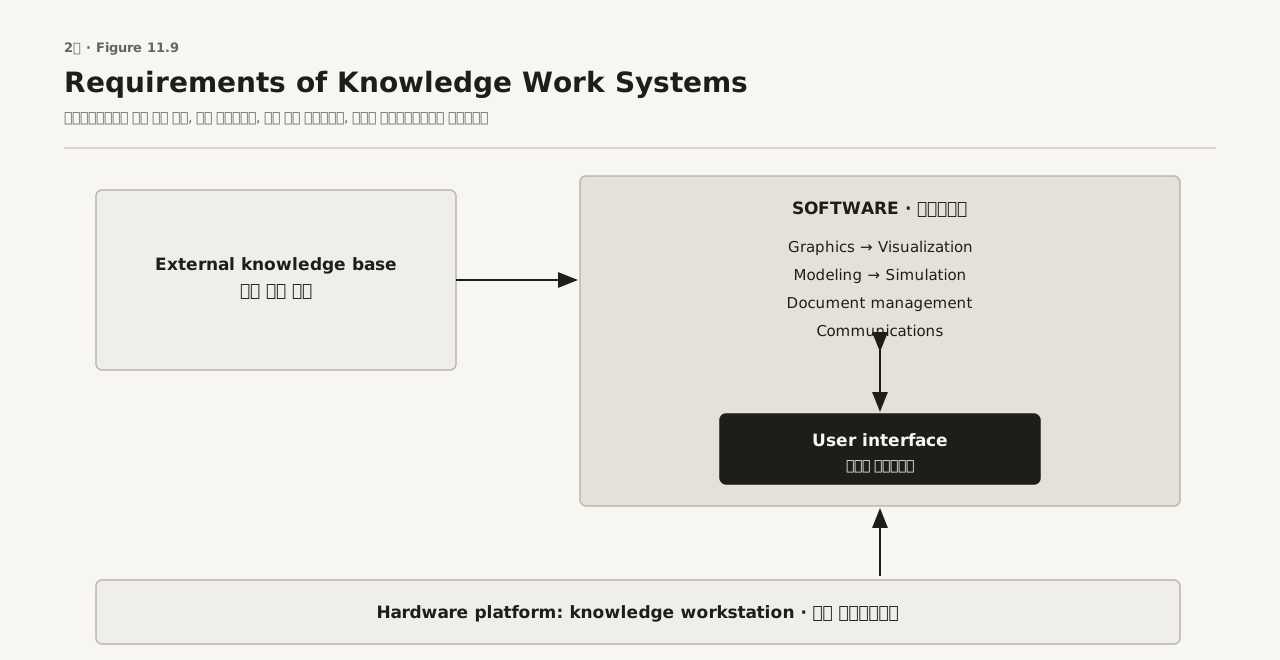
Figure 11.9 · Requirements of Knowledge Work Systems — 외부 지식, 전문 소프트웨어, 인터페이스, 워크스테이션.
개념도 · Knowledge Work System의 구성 층위
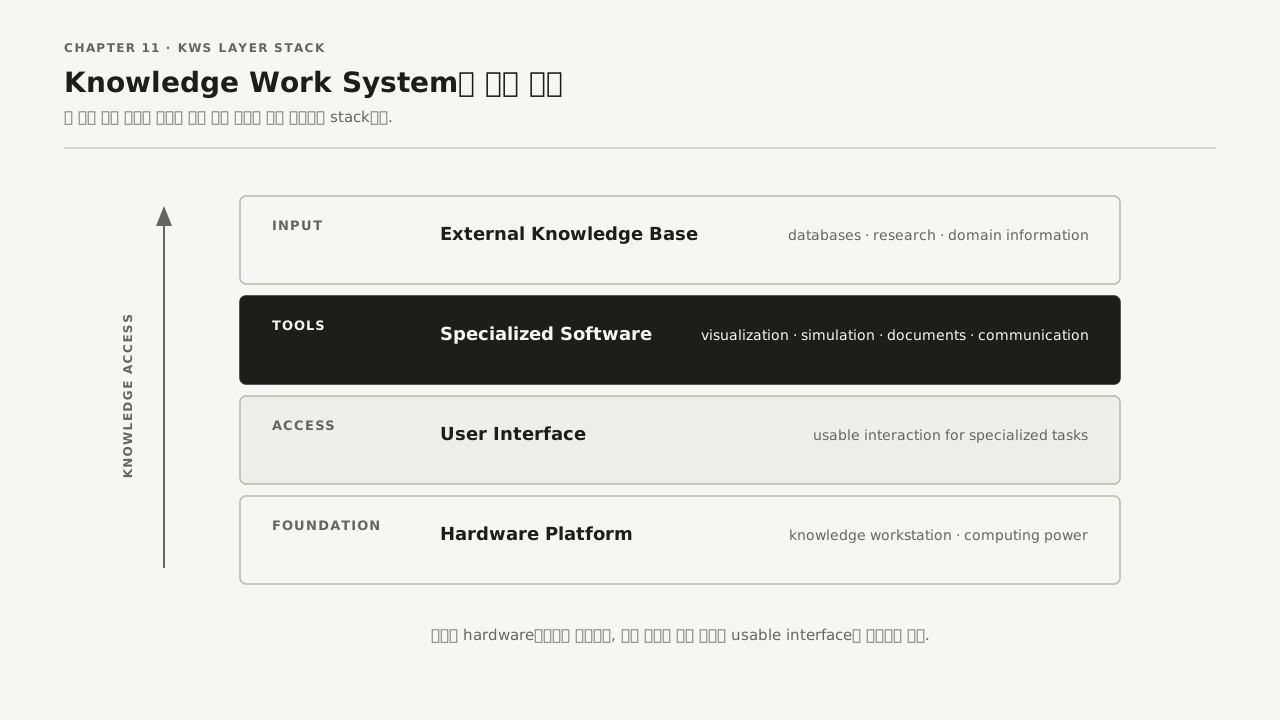
KWS는 한 가지 software의 이름이 아니라, 전문 작업에 필요한 기반·접근 방식·도구·외부 지식이 맞물린 전체 작업 환경이다.
Slide 65 — Examples of Knowledge Work Systems
CAD
- engineering / architectural design
- 3D printing
Virtual Reality
- real-life environment simulation
- 3D medical modeling
Augmented Reality
- physical environment 위에 digital data / image overlay
Investment Workstations
- internal + external financial data 통합
- brokers / traders / portfolio managers 지원
KWS는 전문직이 복잡한 knowledge creation task를 수행하도록 설계된 specialized system
Slide 66 — Intelligent Techniques for Knowledge Management
Traditional Intelligent Techniques
| 목적 | Technique |
|---|---|
| Tacit knowledge capture | expert systems / case-based reasoning / fuzzy logic |
| Knowledge discovery | neural networks / data mining |
| Complex problem solution | genetic algorithms |
| Task automation | intelligent agents |
Modern Techniques
| Technique | 역할 |
|---|---|
| Machine Learning | patterns identify / outcomes predict |
| NLP | documents / conversations의 meaning extract |
| Generative AI | drafts / summaries / code / explanations 생성 |
| RAG | approved enterprise source에 grounded answer 생성 |
| Knowledge Graphs | people / concepts / records / relationships 연결 |
| AI Agents | policy와 human oversight 아래 defined task 실행 |
Intelligent Techniques = knowledge를 capture / discover / generate / apply / automate하는 AI 기반 방법
Slide 67 — Responsible Use of Generative AI
- Govern: ownership / approved use / prohibited use / risk tolerance / accountability
- Map: users / affected people / data / dependencies / misuse identify
- Measure: accuracy / security / privacy / bias / transparency / robustness / human oversight
- Manage: controls / monitoring / incidents / updates / retirement
- Knowledge: AI output을 authoritative knowledge가 아니라 verification이 필요한 claim으로 취급
Responsible AI = Govern → Map → Measure → Manage + Verify
PART 3 · 정보시스템 기능과 조직
Slide 68 — Information Systems Department
- IT services를 책임지는 formal organizational unit
- 보통 CIO가 이끎
Senior Roles
| Role | 핵심 영역 |
|---|---|
| CIO | information systems / IT leadership |
| CSO / CISO | security |
| CKO | knowledge |
| CPO | privacy |
| CDO | data |
| CAIO | AI / responsible AI leadership |
Members
- programmers
- systems analysts
- information systems managers
Systems Analyst
- business problems / requirements → information requirements / systems로 translate
IS Department = business need와 technology를 연결하고 IT services를 운영하는 조직
Slide 69 — Organizing the Information Systems Function
End Users
- applications를 사용하는 other departments의 representatives
- system design / development 참여 증가
IT Governance
- organization에서 IT를 사용하는 strategies / policies
- decision rights + accountability framework
- IT가 business strategy / objectives를 지원하도록 보장
Organization
- centralized / decentralized 등 가능
IT Governance = 누가 IT 결정을 내리고 누가 책임지는지 정의하는 framework
교수님 메모: 시스템 개발이 성숙하면서 end user가 성공적인 시스템 개발의 핵심(pivotal)으로 인정받게 되었다. IS 부서도 신제품·서비스·효율을 만드는 강력한 자원으로 인정받으므로 IT governance는 핵심 경영 관심사다. 교재: 초기 IS 부서는 주로 프로그래머였지만, 지금은 systems analyst와 네트워크 전문가 비중이 커지고 IS 부서가 강력한 변화 주도자(change agent) 역할을 한다.
Slide 70 — Modern Information Systems Operating Model
| Central Responsibilities | Distributed Responsibilities |
|---|---|
| enterprise architecture | business outcomes 정의 |
| cybersecurity | work prioritization |
| shared platforms | process improvement |
| data standards | adoption management |
| vendor management | business product team 실행 |
| service reliability | data accountability 공유 |
| organization-wide governance | responsible AI accountability 공유 |
Modern IS = 핵심 standards/governance는 중앙화하고 business execution은 분산 협업
Slide 71 — Career Relevance
Related Careers
- Business Systems Analyst
- Product Manager / Product Owner
- Data / BI Analyst
- Cybersecurity / Privacy Specialist
- Enterprise Applications / Cloud Consultant
- AI Business Process Analyst
- Information / Knowledge Manager
Career Advantage
- business process knowledge
- data literacy
- collaboration
- responsible AI use
강점 = Business + Data + Technology + Collaboration + Responsible AI를 연결하는 능력
원본 PDF의 진로 사례: 회사 Comprehensive Supplemental Insurance USA, 직무 Sales support specialist — Job requirements, Interview questions, Author tips로 구성. (17판 원본 슬라이드에는 Microsoft Teams·SharePoint와 AI 협업 슬라이드도 함께 있었다.)
Slide 72 — Current Career Context
Workforce Change
- macrotrends로 job creation / displacement 동시 발생
- World Economic Forum: 2030년까지 일자리 1억 7천만 개 창출, 9,200만 개 대체(displaced) 전망
Growing Roles
- big data specialists
- AI / ML specialists
- software developers
Important Business Roles
- operations managers
- project managers
- security specialists
- BI professionals
Task Design
- human work + technology + human-machine collaboration의 혼합 증가
Student Focus
- redesign processes
- evaluate evidence
- communicate with stakeholders
- use AI responsibly
미래 경쟁력은 AI 자체보다 process redesign + evidence + stakeholder communication 능력에서 나옴
Slide 73 — Learning Check
| Topic | Learning Check |
|---|---|
| Process | AI-enabled process는 simple task automation과 어떻게 다른가? |
| Enterprise Systems | ERP / analytics가 cloud로 이동할 때 어떤 management risks가 증가하는가? |
| Collaboration | human-agent team의 reliable work를 위해 어떤 controls가 필요한가? |
| Knowledge | enterprise content가 RAG에 적합하려면 무엇이 필요한가? |
| Sustainability | IS investment decision에 어떤 environmental measures를 포함해야 하는가? |
시험 체크: AI process / Cloud ERP risk / Human-Agent control / RAG-ready knowledge / Sustainability
사례 총정리 · 2장 B에 나오는 예시와 수치
| 슬라이드 | 기업·사례 | 내용 | 핵심 수치·결과 | 연결 개념 |
|---|---|---|---|---|
| 31 | Sharp (Yammer), Cemex | 사내외 소셜 플랫폼 | 경영진 개입 없는 정보 교환 | Social business |
| 32 | Microsoft 2026 연구 | 10개국 AI 사용자 2만 명 | 실수 공유 61% vs 36%, 품질 기준 논의 54% vs 29% | Human-agent teams |
| 34 | 내부 정치로 실패한 팀 | 저품질 협업의 예 | — | Collaboration capability |
| 35 | Google 2024 | 데이터센터 | 배출 12%↓, 청정에너지 8 GW+, Ironwood TPU 약 30배 효율 | 디지털 인프라의 환경 발자국 |
| 37 | Second Life, Google Docs, Teams, SharePoint, Slack, Zoom, Notion | 협업 도구 | — | Collaboration tools |
| 37 | AI Accelerates Drug Discovery | 사람–AI 협업 신약 개발 | 신약 10–15년, AI가 특성 예측·이미지 분석·새 화합물 아이디어 | Human-AI collaboration |
| 38 | Facebook → 기업용 SNS, Yammer | 기능 재현 | Facebook엔 팀 작업공간 없음 | Enterprise social networking |
| 42 | 정보 경제 | 지식·정보 근로자·GDP·NYSE | 37%, 55%, 주식 가치 절반 이상 무형 | KMS의 중요성 |
| 43 | 가전제품 회사 | 가장 효율적이고 싼 에어컨 제조법 | — | Knowledge = firm asset |
| 46 | build-to-order 생산 시스템 | 따라 하기 어려운 노하우 | — | Core competency |
| 47 | Apple, eBay, Burger King | 기업 지식 | 숙련 노동력은 대체 어려움 | Organizational learning |
| 56 | 기업 콘텐츠 | 80% semistructured·unstructured | 조직마다 직접 측정 | Enterprise-wide KM |
| 57 | 출판사·광고사·로펌·방송사 | Digital asset management | — | CMS |
| 65 | CAD·3D printing, VR 3D 의료 모델링, AR, VRML, 투자 워크스테이션 | 전문가 작업 | — | KWS |
| 68 | CIO, CSO/CISO, CPO, CKO, CDO, CAIO | C-level 직책 | — | IS function |
| 72 | World Economic Forum | 2030년까지 | 1억 7천만 창출, 9,200만 대체 | Career context |
2장 사례 — Microsoft 2026 연구의 대상과 두 비교 수치는?
10개국 AI 사용 근로자 2만 명과 Microsoft 365 데이터. Frontier Professionals는 AI 활용법과 실수를 팀과 더 자주 공유(61% vs 36%)하고 품질 기준을 더 자주 논의(54% vs 29%)한다.
2장 사례 — Google 2024의 환경 관련 수치 세 가지는?
데이터센터 에너지 배출 12% 감소, 8 GW 이상의 청정에너지 계약, Ironwood TPU가 2018년 첫 Cloud TPU보다 전력 효율 약 30배.
2장 사례 — 정보 경제를 보여 주는 Slide 42의 수치는?
미국 노동력의 37%가 지식·정보 근로자, 미국 GDP의 55%가 지식·정보 부문, NYSE 상장 주식 가치의 절반 이상이 지식·노하우 같은 무형 자산.
2장 사례 — 조직 비즈니스 콘텐츠 중 semistructured·unstructured 비율과 최신 메모는?
80%. 단, 비율은 조직마다 다르므로 관리자는 자기 조직의 콘텐츠를 직접 측정해야 한다.
2장 사례 — KWS의 슬라이드 예시를 모두 쓰면?
CAD(3D printing 포함), virtual reality(외과의를 위한 3D 의료 모델링), augmented reality, VRML, investment workstations(브로커·트레이더·포트폴리오 매니저).
2장 사례 — CSO, CPO, CKO, CDO, CAIO의 책임은?
CSO = IS 보안·보안 정책 시행(CISO), CPO = 개인정보 법규 준수, CKO = 지식관리 프로그램, CDO = 전사 데이터 거버넌스·활용, CAIO = AI 전략·도입·모니터링.
2장 사례 — AI Accelerates Drug Discovery 사례에서 AI가 돕는 세 가지는?
후보 화합물의 특성을 예측해 가망 없는 작업을 막음, 수천 장의 세포 이미지 분석 같은 반복 작업을 줄임, 새로운 화합물 아이디어를 생성. 신약 개발은 보통 10–15년 이상 걸린다.
단원 마무리
한 쪽 핵심 요약
| 주제 | 꼭 기억할 것 |
|---|---|
| 협업 | 역량(개방 문화·분권 구조) + 기술 → 협업의 질 → 기업 성과 |
| 시간·공간 매트릭스 | 같은/다른 시간 × 같은/다른 장소의 네 칸 |
| 지식의 형태 | Explicit(문서) vs Tacit(경험), 지식은 sticky·situated·contextual |
| KM 가치사슬 | Acquire → Store → Disseminate → Apply, Apply가 있어야 가치 |
| KMS 세 유형 | 전사 KMS(관리) · KWS(창출) · 지능형 기법(발견) |
| 콘텐츠 관리 | Taxonomy와 tagging이 검색의 핵심 |
| IS 조직 | CIO · systems analyst · IT governance(decision rights + accountability) |
단답형 연습 · Short Answer
Write the term or a short answer in English. 답은 맨 끝 정답과 해설의 단답형 정답에서 확인한다.
- What is the use of internal and external social networking platforms to engage employees, customers, and suppliers called?
Answer: ______________________________ - In the time/space collaboration matrix, what do we call collaboration that happens at the same time?
Answer: ______________________________ - What is knowledge that resides in the minds of employees and has not been documented called?
Answer: ______________________________ - What do we call the process by which organizations gain experience and change their business processes and decision patterns as a result?
Answer: ______________________________ - List the four stages of the knowledge management value chain.
Answer: ______________________________ - What are informal social networks of professionals and employees who share similar work-related activities and interests called?
Answer: ______________________________ - Which type of KMS supports engineers and scientists in creating new knowledge, such as CAD and virtual reality systems?
Answer: ______________________________ - What is the scheme of classifying information and knowledge so that it can be easily accessed called?
Answer: ______________________________ - Who in the IS department translates business problems and requirements into information requirements and systems?
Answer: ______________________________ - What framework specifies the decision rights and accountability that ensure IT supports the firm's strategies and objectives?
Answer: ______________________________
개념 회상과 오개념 점검
Knowledge Management Value Chain을 순서대로 쓰고, 마지막 단계가 빠지면 왜 business value가 생기기 어려운지 설명하시오.
정답 확인
Acquisition → Storage → Dissemination → Application이다. 지식을 저장하고 공유해도 실제 decision이나 business process에 적용하지 않으면 성과 개선으로 연결되지 않는다.
explicit knowledge와 tacit knowledge의 차이를 각각 하나의 조직 사례로 설명하시오.
정답 확인
explicit knowledge는 매뉴얼·보고서처럼 기록하고 전달하기 쉬운 지식이다. tacit knowledge는 숙련자의 문제 해결 감각처럼 개인의 경험에 묻혀 있어 문서만으로 완전히 옮기기 어려운 지식이다.
AI-ready content를 만들 때 taxonomy, metadata, access control이 함께 필요한 이유는 무엇인가?
정답 확인
taxonomy와 metadata는 관련 지식을 정확히 찾고 맥락을 해석하게 하며, access control은 허가된 정보만 사용하게 한다. 셋 중 하나가 빠지면 검색 정확성이나 보안이 약해진다.
A firm has stored thousands of project reports, but employees cannot find relevant lessons and no process uses them. Which KM stage is the clearest bottleneck?
- A. Acquisition only
- B. Storage only
- C. Dissemination and application
- D. Hardware platform only
정답 확인
정답은 C이다. A는 자료가 이미 수집되었다는 조건을 놓친 선택이다. B는 저장 자체를 가치 창출로 보는 오개념이다. D는 KM 문제를 hardware 문제로만 축소한 선택이다. 찾을 수 있게 전달하고 실제 업무에 적용해야 지식이 성과로 이어진다.
정답과 해설
먼저 스스로 답을 쓴 뒤 확인한다.
확인 문제 정답
- Collaboration capability(개방적 문화, 분권적 구조, 협업의 폭)와 collaboration technology.
- Same time · different place → Remote interactions.
- 정보를 숨기지 않는 정보 투명성과 공유를 보상하는 문화.
- Acquisition → Storage → Dissemination → Application.
- Explicit knowledge는 문서화된 지식이고, tacit knowledge는 사람의 경험 속에 있어 문서로 옮기기 어려운 지식이다.
- Enterprise-wide KMS, knowledge work systems, intelligent techniques.
- CIO(Chief Information Officer).
- Decision rights(누가 결정하는가)와 accountability(누가 책임지는가).
- 중앙집중형(centralized). 분산형은 현장 대응과 자율성에 유리하다.
단답형 정답
- Social business — 소셜 플랫폼으로 직원·고객·공급업체와의 상호작용을 깊게 하는 것
- Synchronous collaboration — 같은 시간에 이루어지는 동기식 협업
- Tacit knowledge — 문서화되지 않고 사람의 경험 속에 있는 암묵지
- Organizational learning — 경험을 바탕으로 프로세스와 의사결정 방식을 바꾸는 조직 학습
- Acquisition, storage, dissemination, application — 획득 → 저장 → 전파 → 적용
- Communities of practice (COPs) — 같은 일을 하는 사람들의 비공식 네트워크
- Knowledge work systems (KWS) — 전문가의 새 지식 창출을 돕는 지식작업시스템
- Taxonomy — 콘텐츠를 쉽게 찾도록 분류하는 체계
- Systems analyst — 현업 요구를 시스템 요구사항으로 번역하는 시스템 분석가
- IT governance — IT 결정 권한과 책임을 정하는 IT 거버넌스
내용을 이해했다면 학습 완료를 체크해 주세요.