2장 A · 프로세스에서 전사 시스템까지
이번 강의에서 배울 것
- 비즈니스 프로세스와 정보시스템의 관계를 설명한다.
- TPS·MIS·DSS·ESS를 관리 수준과 의사결정 유형에 따라 구분한다.
- ERP·SCM·CRM·KMS가 조직의 어떤 경계를 연결하는지 비교한다.
학습 경로
범위: Chapter 2 슬라이드 2–29 · Process → Management Systems → Enterprise Integration
Chapter 2 원본 PDF · Chapter 2 확장 PDF
단원 도입
| 출제 포인트 | 빈도 | 이렇게 나온다 |
|---|---|---|
| TPS · MIS · DSS · ESS 구분 | ★★★ | 사용자와 결정 유형으로 시스템 고르기 |
| ERP · SCM · CRM · KMS 구분 | ★★★ | 연결하는 경계로 시스템 고르기 |
| Business process, cross-functional | ★★ | 정의, 주문 이행 사례 |
| IT가 프로세스를 바꾸는 두 방식 | ★★ | 자동화 vs 재설계 |
| Intranet · Extranet · E-business | ★★ | 범위와 포함 관계 |
책 읽는 법: 슬라이드 제목 아래의 짧은 목록과 요약 한 줄이 강의 핵심 필기다. 개념은 정의, 판서는 한눈 정리, 해설은 쉬운 설명, 오답 주의는 시험 함정, 예제는 풀이 연습, 확인 문제의 답은 단원 끝 정답과 해설에 있다.
형광펜 읽는 법: 노랑 핵심 정의·결론 · 빨강 시험에서 헷갈리는 구분·함정 · 파랑 외워야 할 순서·목록
Chapter 2 개요
- Chapter 2 주제: business processes, management systems, enterprise applications, collaboration, knowledge management
기업의 업무 흐름과 의사결정을 information systems가 어떻게 지원하는지 보는 장
예시 박스 읽는 법: 예시 박스는 슬라이드에 나온 실제 기업 사례와 교수님 메모를 교재 설명으로 보충한 것이다. 시험에서 “이 사례는 어떤 시스템·개념인가?”로 나오므로 기업 → 시스템 → 결과 → 개념을 함께 외운다. 장 끝 사례 총정리에 한 표로 모았다. 카페 예시는 이해를 돕는 짧은 가상 사례다.
Slide 2 — Learning Objectives
- Business Processes ↔ Information Systems 관계
- management level별 system: TPS / MIS / DSS / ESS
- enterprise-wide applications: ERP / SCM / CRM / KMS
- Collaboration / Social Business의 필요성과 도구
- Knowledge Management Systems
- Information Systems Function / Career
핵심 흐름: Process → Systems → Enterprise Integration → Collaboration → Knowledge → IS Function
PART 1 · 비즈니스 프로세스와 IT
Slide 3 — Sharp Corporation Case (1/2)
Problem
- hierarchical top-down processes
- new competitors
- 부족한 collaboration / idea sharing
Solution
- knowledge-sharing strategy와 goal 설정
- knowledge-sharing / collaboration process 재설계
- organizational culture 변화
- Microsoft Yammer 도입
문제는 단순히 software 부족이 아니라 process + culture + collaboration의 문제
Slide 4 — Sharp Corporation Case (2/2)
- new information systems를 사용해 performance / competitiveness 개선
- teamwork + collaboration → innovation / profit growth
- knowledge dissemination에는 organizational culture + business processes가 중요
Information system의 효과는 technology만이 아니라 organization과 process에 달려 있음
Slide 5 — Business Processes (1/2)
- Business Process
- material / information / knowledge의 flow
- 특정 business task를 수행하는 logically related set of tasks
- 한 functional area 내부 또는 cross-functional 가능
- business = 여러 business processes의 집합으로 볼 수 있음
- business process는 asset 또는 liability가 될 수 있음
- outdated process → responsiveness / efficiency 저하
Business Process = 업무를 수행하는 연결된 task들의 흐름
답안 틀: 무엇이 흐르는가(material · information · knowledge) → 어떤 task가 이어지는가 → 한 부서 안인가, 여러 부서를 가로지르는가.
Slide 6 — Business Processes (2/2)
Functional Business Processes
| Functional Area | 주요 Business Process |
|---|---|
| Manufacturing & Production | assembling product / quality checking |
| Sales & Marketing | identifying customers / selling product |
| Finance & Accounting | financial statements / paying creditors |
| Human Resources | hiring employees / evaluating job performance |
각 functional area마다 고유한 business process가 존재
Slide 7 — Figure 2.1 Order Fulfillment Process
Flow
Sales
- Generate order → Submit order
↓
Accounting
- Check credit → Approve credit → Generate invoice
↓
Manufacturing & Production
- Assemble product → Ship product
Key
- 하나의 customer order가 여러 functional areas를 통과
- 중요한 business process는 보통 cross-functional
Order fulfillment = Sales + Accounting + Manufacturing의 coordination
교재 그림 · Figure 2.1
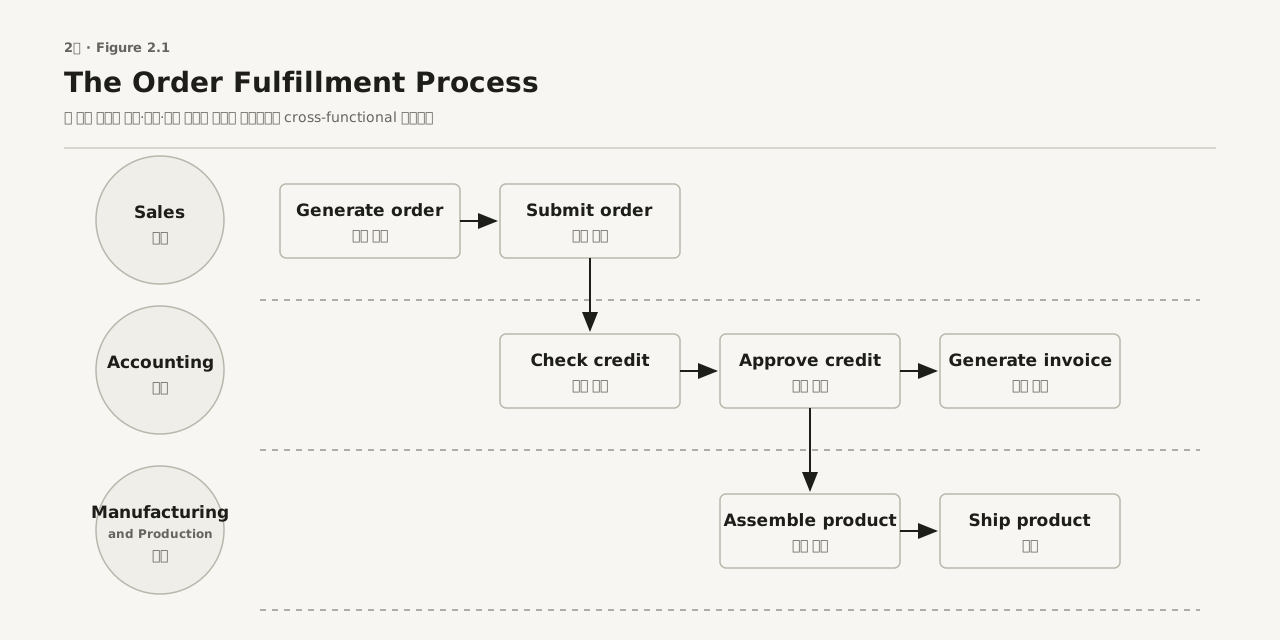
Figure 2.1 · The Order Fulfillment Process — 한 주문이 세 기능 부서를 가로지른다.
개념도 · 한 주문이 부서를 가로지르는 과정
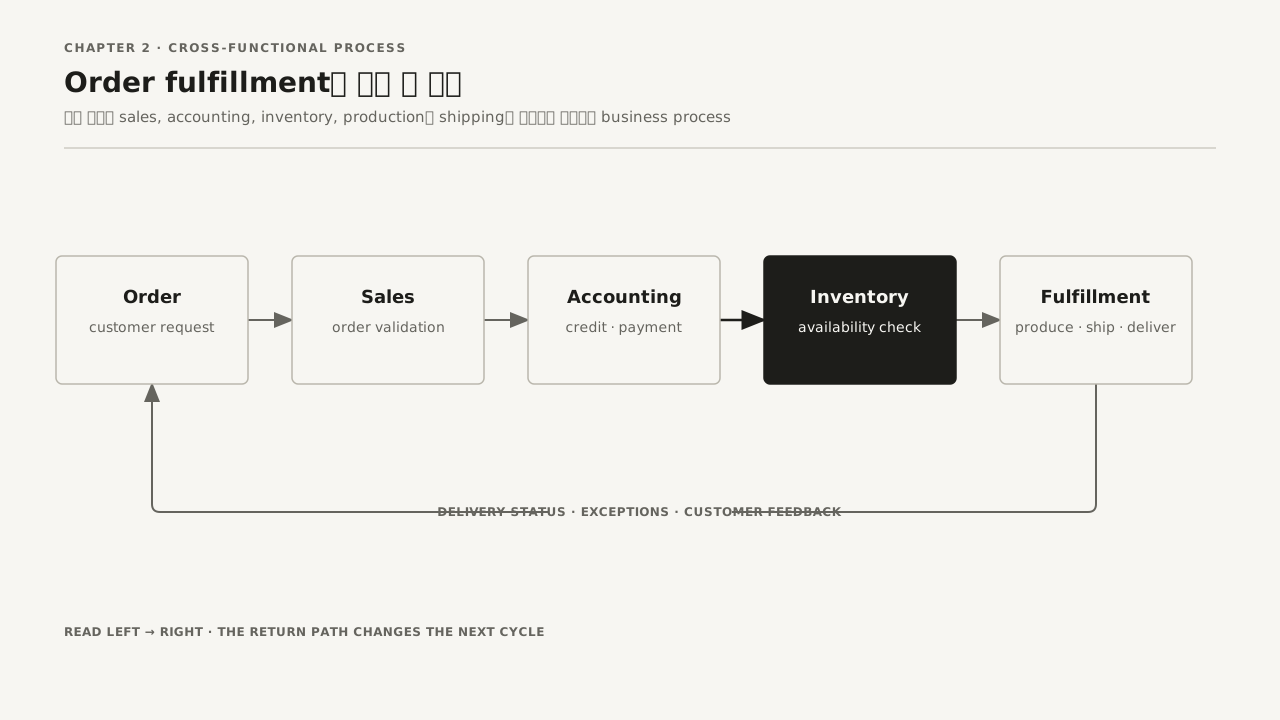
그림 읽기: order fulfillment는 한 부서의 독립 작업이 아니라 여러 functional area가 같은 주문 정보를 넘겨받는 cross-functional process이다. 어느 한 단계의 지연이나 오류도 전체 delivery outcome에 영향을 준다.
Slide 8 — How IT Improves Business Processes
1. Existing Process 효율화
- manual steps를 automation
2. Entirely New Process 가능
- information flow 변경
- sequential steps → parallel steps
- decision-making delay 제거
- new business models 지원
Example
- digital music download
- e-book purchase / one-click purchase
IT는 기존 process를 빠르게 만들 뿐 아니라 새로운 process 자체를 가능하게 함
자동화와 프로세스 재설계의 차이는 업무 순서가 바뀌었는가로 확인할 수 있다. 기존 승인 절차를 그대로 두고 입력만 빨라졌다면 효율화이고, 같은 주문 정보를 여러 부서가 동시에 확인해 순차적인 전달·대기를 줄였다면 정보 흐름 자체를 바꾼 것이다.
Slide 9 — AI Changes the Design of Business Processes
| Role | Human / AI 관계 | 핵심 |
|---|---|---|
| Assist | Human이 process 수행 | AI가 retrieve / summarize / draft / recommend |
| Automate | System이 routine steps 수행 | rules / models가 repeatable work 수행 |
| Agent | AI가 defined workflow 수행 | tools / systems 호출, permissions / monitoring / escalation 필요 |
AI 활용 수준: Assist → Automate → Agent
세 수준의 차이는 AI가 결과를 만드는 데서 끝나는지, 실제 업무 단계를 수행하는지에 있다. Assist에서는 사람이 제안을 검토해 행동하고, Automate에서는 정해진 반복 단계를 시스템이 처리한다. Agent가 여러 도구를 이용해 흐름을 이어 간다면 권한 범위와 사람이 넘겨받아야 할 예외를 먼저 정해야 한다.
PART 2 · 관리 계층별 정보시스템
Slide 10 — TPS (Transaction Processing Systems)
- Target: operational managers & staff
- Function: perform + record daily routine transactions
- sales order entry / payroll / shipping
- Purpose: operations status와 external environment monitor
- Decision: predefined + structured
- routine questions에 답하기 위한 필수 system
TPS = operational level의 반복적이고 structured한 transaction을 처리·기록
교수님 메모: TPS의 목적은 조직 안 거래 흐름에 대한 routine questions에 답하는 것이며, 모든 비즈니스의 필수품(necessity)이다. 오래전부터 써 온 시스템이라 aka. legacy systems라고도 부른다. 예: sales order entry, payroll, shipping.
Slide 11 — Figure 2.2 Payroll TPS
Input
- Employee Data
- Employee/File Database
- pay rate / gross pay / tax / net pay 등
Processing
- Payroll System
- employee payment transaction 처리
Output
- employee paychecks
- management reports
- General Ledger
- government agencies
- online queries
Employee Data → Payroll Processing → Paychecks / Reports / Ledger / Government
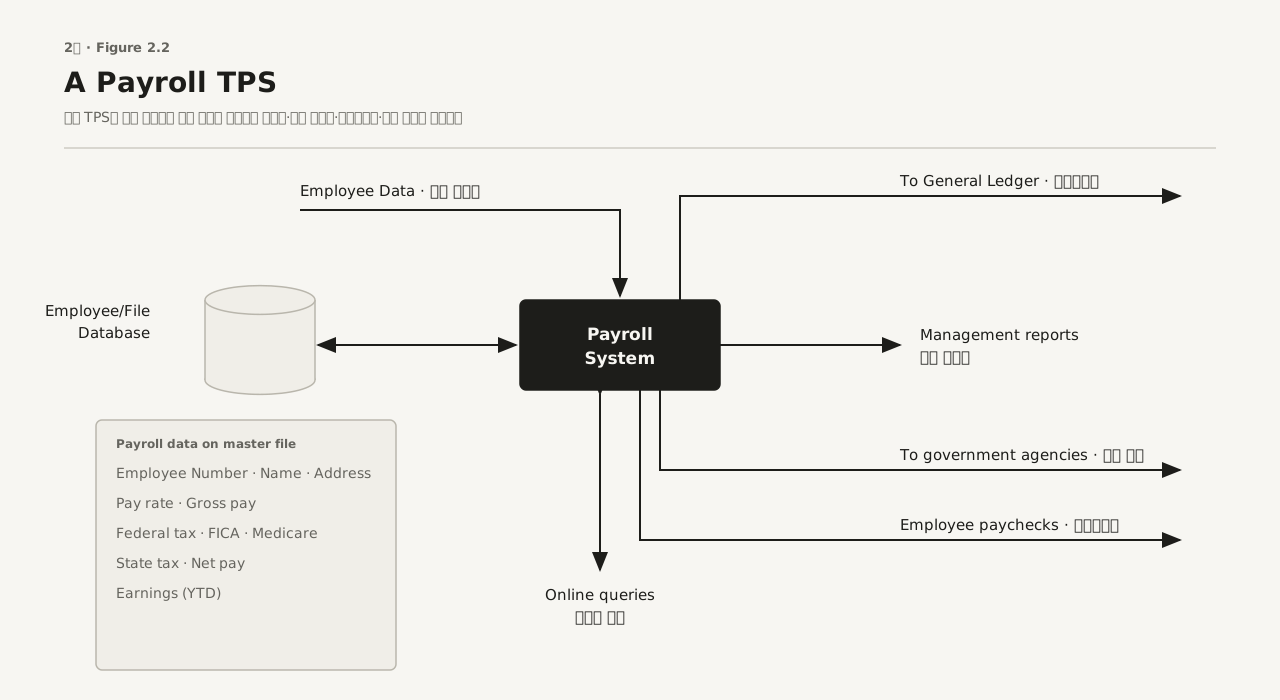
Figure 2.2 · A Payroll TPS — 하나의 거래 처리 결과가 여러 사용자에게 다른 형태로 쓰인다.
교수님 메모: 급여 TPS의 입력은 time card(근무시간 기록) 같은 직원 지급 거래 데이터이고, 출력은 관리자용 온라인·인쇄 보고서와 급여명세서다. 급여 시스템의 출력은 회사 안의 관리자뿐 아니라 규제기관(regulatory agencies)과 보고 데이터의 정확성에 의존하는 다른 기관에도 유용하다.
Slide 12 — Business Intelligence (BI)
- Definition: data + software tools for organizing & analyzing data
- Purpose: support better decision making
Related Systems
| System | 역할 |
|---|---|
| MIS | routine report / current performance 제공 |
| DSS | non-routine decision 분석 지원 |
| ESS | senior management의 strategic decision 지원 |
BI = data를 organize/analyze해서 decision making을 지원하는 tools
Slide 13 — Management Information Systems (MIS)
- Target: middle management
- Input: data from TPS
- Output: firm의 current performance report
- routine questions + predefined procedures
- analytic capability가 적고 flexible하지 않음
주의
- 학문 분야로서의 MIS와 system 종류로서 MIS는 의미가 다름
MIS = TPS data를 요약해 middle managers에게 정기 report 제공
교수님 메모: 대부분의 MIS는 단순한 루틴(simple routine)을 쓴다. 이 장의 MIS는 중간관리자를 위한 특정 시스템 유형이고, 1장의 MIS(비즈니스의 정보시스템 전체를 연구하는 학문)와 이름은 같지만 뜻이 매우 다르다.
Slide 14 — Figure 2.3 TPS → MIS
TPS
- Order processing system
- Materials resource planning system
- General ledger system
↓ summarized transaction data
MIS Files
- Sales data
- Unit product cost data
- Product change data
- Expense data
↓
MIS
↓
Output
- Reports
- Online Displays / Dashboards
↓
Users
- Managers
TPS → summarized data → MIS → Reports / Dashboards → Managers
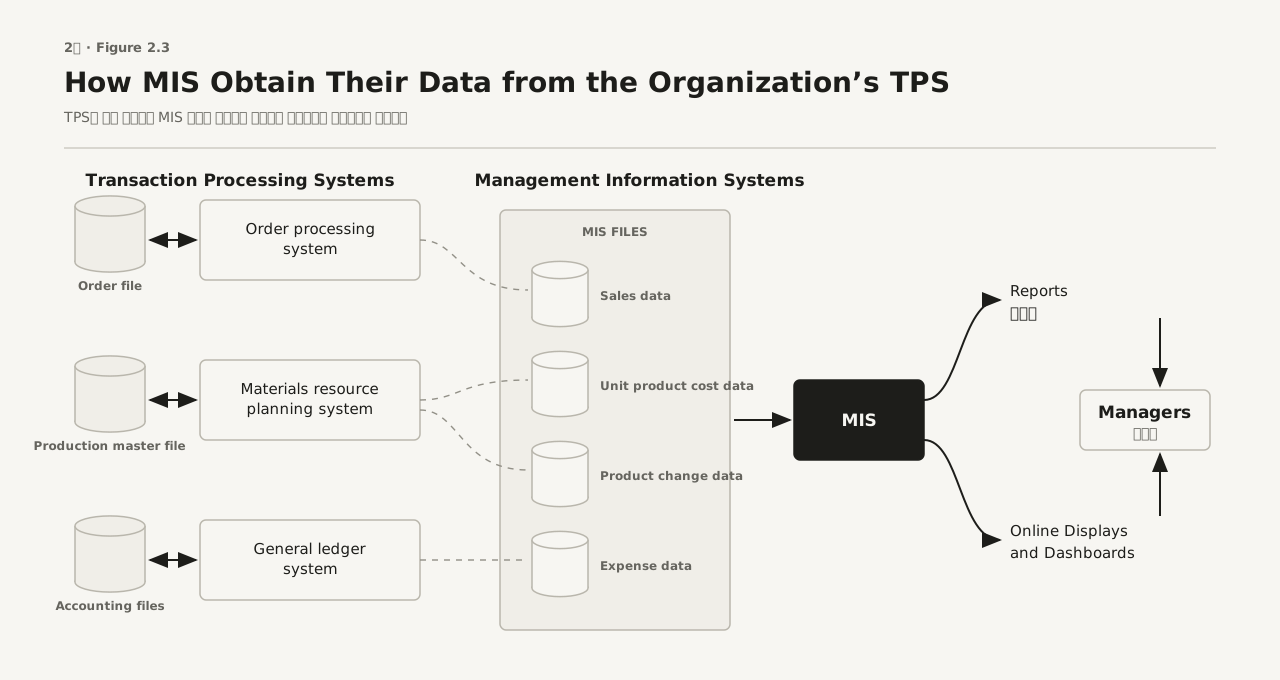
Figure 2.3 · How MIS Obtain Their Data from the Organization’s TPS — TPS의 거래 데이터를 요약해 보고서로 만든다.
Slide 15 — Figure 2.4 Sample MIS Report
- MIS가 만든 summarized annual sales report
- 핵심 비교: Actual Sales ↔ Planned Sales
Actual Versus Planned
| 값 | 의미 |
|---|---|
> 1.00 | Actual Sales > Planned Sales |
= 1.00 | 실제 = 계획 |
< 1.00 | Actual Sales < Planned Sales |
Example
| 값 | 해석 |
|---|---|
1.19 | 계획의 119% 판매 |
0.85 | 계획의 85% 판매 |
MIS report는 manager가 performance를 비교·monitor하기 쉽게 요약한 정보
Slide 16 — Decision Support Systems (DSS)
- Target: middle management
- Purpose: non-routine decision making 지원
- ex) December sales가 2배라면 production schedule 영향?
- Data
- internal: TPS / MIS data
- external information 가능
Types
- Model-driven DSS: analytical model 중심
- Data-driven DSS: large data에서 useful information 추출
DSS = analytical model / data를 이용해 non-routine decision 지원
MIS와 DSS는 사용자나 데이터만으로 구분하면 헷갈린다. 같은 middle manager가 같은 판매 기록을 보더라도, MIS는 ‘계획 대비 실적이 얼마인가’를 정해진 형식으로 보여 주고 DSS는 ‘수요가 달라지면 어떤 선택이 유리한가’를 분석한다. 핵심은 정기적인 현황 확인인지, 조건을 바꿔 보는 판단인지이다.
Slide 17 — Figure 2.5 Voyage-Estimating DSS
Data
- ship speed / capacity
- port distance / restrictions
- fuel consumption cost
- charter hire history cost
- port expense
↓
Analytical Models Database
↓
Decision Support
- 어떤 vessel을 어느 destination에 보낼지
- optimal loading pattern
- optimal speed
- profit maximization
다양한 data + analytical model → shipping bid와 운항 의사결정 지원
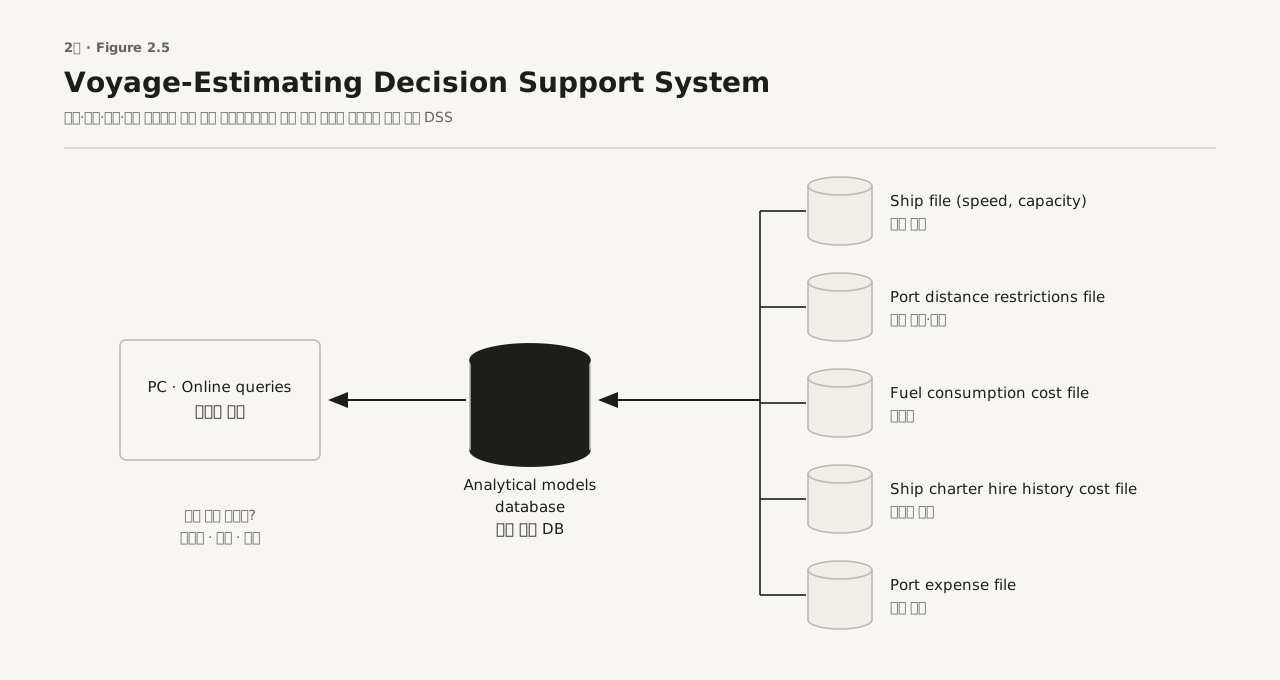
Figure 2.5 · Voyage-Estimating Decision Support System — 대표적인 모델 중심 DSS.
Slide 18 — Executive Support Systems (ESS) (1/2)
- Target: senior management
- Purpose: non-routine / strategic decisions 지원
- 요구되는 것
- judgment
- evaluation
- insight
Data
- external events
- tax law / competitors
- summarized internal information from MIS + DSS
Example
- Digital Dashboard
- real-time KPI / financial performance
- working capital / cash flow / inventory
ESS = senior managers가 strategic decision을 빠르게 내리도록 핵심 정보를 제공
Slide 19 — ESS + MIS + DSS Connection
- ESS relies on MIS + DSS inputs
- systems는 서로 isolated되면 안 됨
- accurate MIS / DSS data가 ESS 품질을 결정
- modern ESS: Digital Dashboard / ease of use / simple display / quick access
Management System 비교
| System | Main User | Decision | 핵심 역할 |
|---|---|---|---|
| TPS | operational managers & staff | routine / structured | daily transaction 처리·기록 |
| MIS | middle management | routine / predefined | TPS data 요약·report |
| DSS | middle management | non-routine / analytical | model / data 기반 분석 |
| ESS | senior management | non-routine / strategic | 핵심 KPI와 strategic information 제공 |
TPS → MIS / DSS → ESS → Senior Management
개념도 · 관리 수준별 시스템 연결
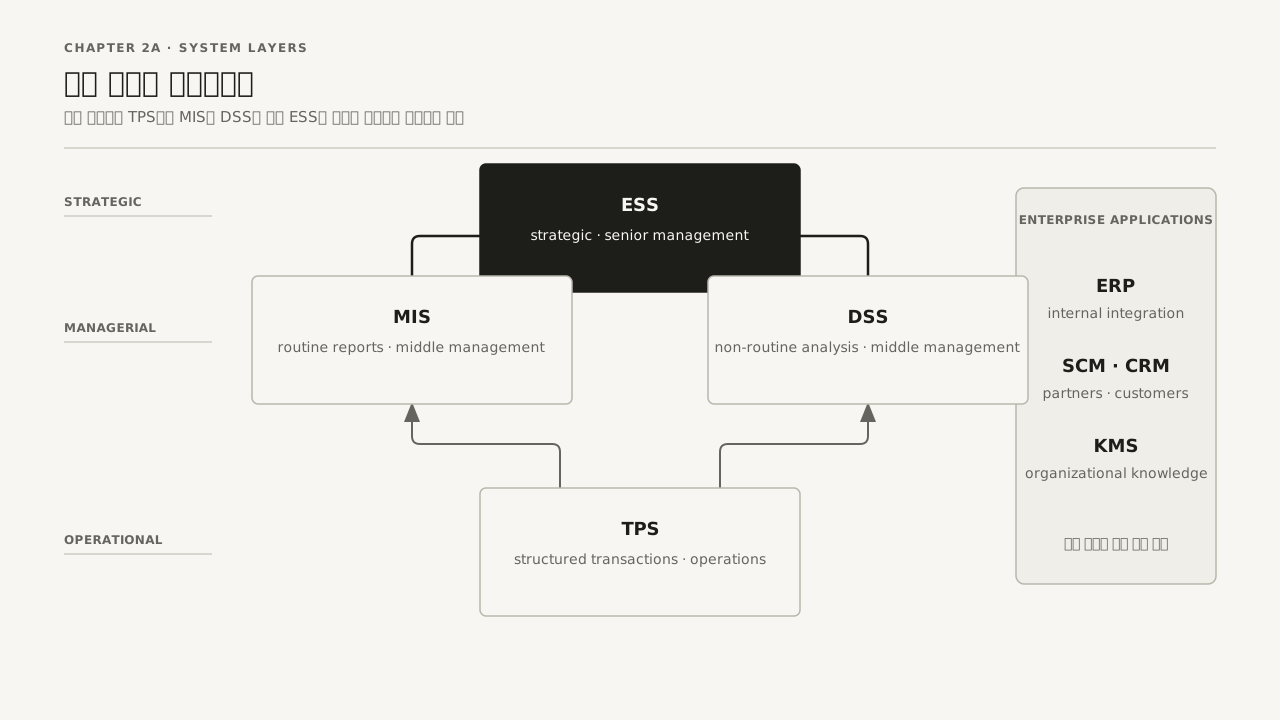
그림 읽기: TPS는 일상 거래를 기록하는 기반이고, MIS는 이를 정기 보고서로 요약하며 DSS는 같은 내부 데이터와 외부 데이터를 분석한다. ESS는 MIS와 DSS의 핵심 정보를 받아 전략적 판단을 지원한다. 오른쪽의 ERP·SCM·CRM·KMS는 특정 계층에만 속하는 시스템이 아니라 부서와 관리 수준의 경계를 가로질러 연결한다.
PART 3 · 전사 애플리케이션과 인터넷
Slide 20 — Enterprise Applications
- enterprise 전체를 linking하는 systems
- 여러 functional areas를 span
- firm-wide business processes 실행
- 모든 management levels 포함
Four Major Applications
| Application | 주요 대상 / 역할 |
|---|---|
| ERP / Enterprise Systems | 내부 functional areas와 data 통합 |
| SCM | suppliers / logistics / supply chain 관리 |
| CRM | customers / sales / marketing / service 관리 |
| KMS | organizational knowledge 수집·공유·활용 |
Enterprise Applications = 여러 부서와 management level을 연결하는 firm-wide systems
교수님 메모: Enterprise applications는 앞에서 본 시스템들이 쓰는 정보를 관리한다. 즉 TPS, MIS, DSS, ESS가 함께 매끄럽게 작동하도록 하는 것이 전사 애플리케이션이다.
Slide 21 — Figure 2.6 Enterprise Application Architecture
Internal Functional Areas
- Sales & Marketing
- Manufacturing & Production
- Finance & Accounting
- Human Resources
Major Systems
- Enterprise Systems → 내부 기능 통합
- SCM → suppliers / business partners 연결
- CRM → customers / distributors 연결
- KMS → organization-wide knowledge 연결
Purpose
- cross-functional process 자동화
- information sharing
- accurate decision information 제공
Enterprise Applications는 내부 부서뿐 아니라 suppliers / customers까지 연결
교재 그림 · Figure 2.6
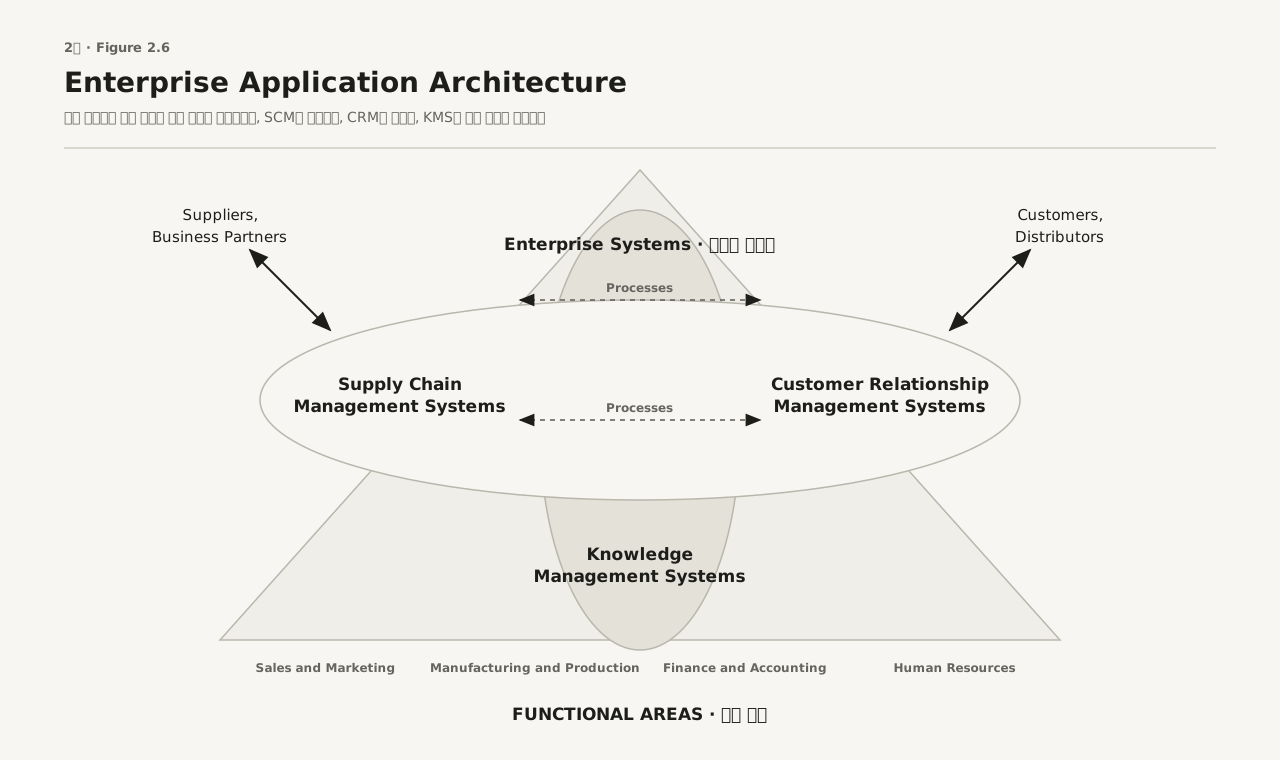
Figure 2.6 · Enterprise Application Architecture — 기능 부서와 관리 계층을 가로지르는 전사 애플리케이션.
개념도 · Enterprise applications의 역할 분담
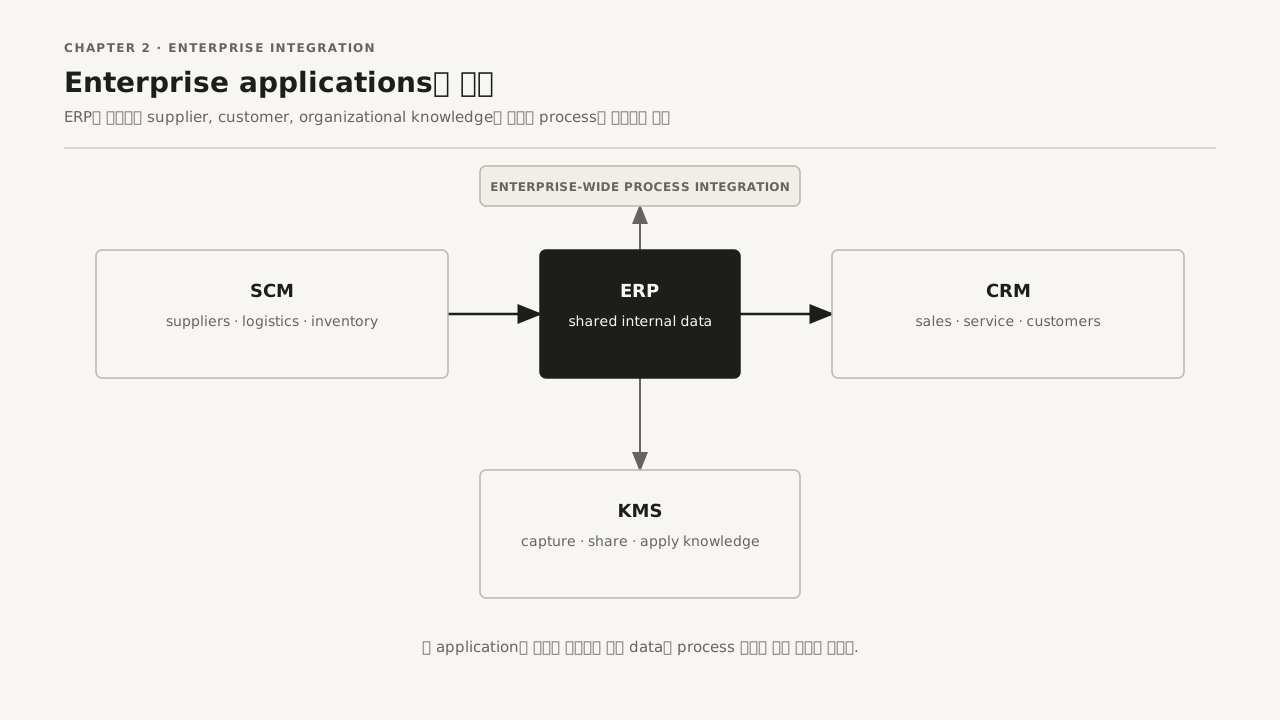
그림 읽기: ERP는 내부 data와 process의 공통 기반이고, SCM과 CRM은 각각 supplier side와 customer side를 연결한다. KMS는 이 과정에서 생긴 know-how를 수집·공유·적용한다. 네 system은 대체 관계가 아니라 서로 다른 경계를 연결한다.
Slide 22 — Enterprise Systems (ES / ERP)
- aka ERP (Enterprise Resource Planning)
- 여러 functional areas의 data 수집
- single central data repository에 저장
- fragmented data problem 해결
Benefits
- information flow 통합
- daily activities coordination
- customer orders에 빠르게 대응
- overall view of operations 제공
- daily operation + long-term planning 지원
구분
- Enterprise Applications = ERP / SCM / CRM / KMS 전체
- Enterprise Systems = 그중 ERP를 의미
ERP = 여러 부서의 data를 하나의 central repository로 통합
앞의 주문 이행 사례에 대입하면 ERP의 의미가 선명해진다. 영업이 입력한 주문을 회계와 생산이 각자 다시 입력하는 대신 같은 기록을 기준으로 업무를 이어 간다. 중앙 저장소의 목적은 데이터를 한곳에 모으는 것 자체보다 부서마다 다른 기록 때문에 생기는 조정 문제를 줄이는 데 있다.
Slide 23 — Enterprise Systems Are Moving to Cloud Platforms
| 관점 | 핵심 내용 |
|---|---|
| Market | Cloud ERP 확산 / SAP Cloud ERP Suite 매출: 2022년 82.09억 → 2025년 181.19억(약 2.2배) |
| Architecture | standardized processes / shared data / APIs / analytics / continuous updates |
| Management | subscription cost / configuration / data migration / integration / skills / vendor dependence |
| AI | ERP에 copilots / agents embedded → decision support / task execution |
ERP trend = on-premise → Cloud ERP + embedded AI
Slide 24 — Supply Chain Management (SCM) Systems
- 관계 관리 대상
- suppliers
- purchasing firms
- distributors
- logistics companies
- shared information
- orders
- production
- inventory levels
Goal
- correct amount of product
- source → point of consumption
- as quickly as possible
- at lowest cost
Type
- inter-organizational system
- organizational boundaries를 넘어 information flow 자동화
SCM = supply chain 전체의 product / information flow를 최적화
교수님 메모: 이 구분(조직 간 시스템)이 중요한 이유는 SCM 시스템이 잠재적 파트너와 공급업체의 비즈니스 프로세스까지 고려해서 설계되어야 하기 때문이다. 대표 사례: 영상 Case 1 Walmart's Retail Link Supply Chain.
Slide 25 — Walmart’s AI-Enabled Supply Chain
| 단계 | 역할 |
|---|---|
| Sense | demand / inventory / transportation / operational signals 수집 |
| Predict | ML로 demand / stock / fulfillment / routing problems 예측 |
| Act | 필요한 location으로 inventory redirect |
| Learn | operating feedback으로 개선 |
| Control | data quality / access / exception / performance / accountability 관리 |
AI-enabled SCM = Sense → Predict → Act → Learn + Control
Slide 26 — Customer Relationship Management (CRM) Systems
- Purpose: customers와의 relationship 관리
- sales / marketing / customer service의 customer-related processes 통합
Goals
- optimize revenue
- improve customer satisfaction
- increase customer retention
- identify & retain profitable customers
- increase sales
CRM = customer data와 customer-facing processes를 통합해 관계와 sales를 개선
교수님 메모: CRM은 마케팅과 고객 서비스 모두에 매우 중요하다. 슬라이드 사례: 영상 US Foodservice Grows Market with Oracle CRM on Demand(클라우드형 CRM으로 시장 확대).
Slide 27 — Knowledge Management Systems (KMS)
- knowledge / expertise를 capture + apply
- relevant knowledge를 collect하고 필요한 곳에서 사용 가능하게 함
- business processes / management decisions 개선
- external knowledge sources와 연결
Example
- product creation know-how
- problem solving method
- best practices
KMS = organizational knowledge를 수집·공유·활용하는 system
교수님 메모: 기업이 지식의 저장소(repositories of knowledge)라는 생각은 낯설 수 있다. 기업 지식의 예: 패스트푸드 식당을 운영하는 데 필요한 지식, Amazon 같은 웹사이트를 운영하는 데 필요한 지식. KMS는 직원이 특정 프로세스를 수행하거나 문제를 해결하는 법을 이해하도록 돕는다. 생각해 볼 것: KMS가 부실한 기업에는 어떤 결과가 생길까?
Slide 28 — Intranets and Extranets
Intranet
- internal network
- Internet standards 기반
- employees only
Extranet
- authorized vendors / suppliers / partners에게 제한적 접근 허용
- supply chain coordination
- collaboration 지원
| Intranet | Extranet | |
|---|---|---|
| 대상 | Employees | Authorized external partners |
| 범위 | Internal | Internal + selected external |
| 목적 | 내부 정보 공유 | 외부 partner와 collaboration |
Intranet = 내부용 / Extranet = 제한된 외부 partner까지 확장
슬라이드 메모: Intranet은 흔히 회사 웹사이트 안의 비공개(private) 접근 영역이고, Extranet은 공급망 조정에 자주 쓰인다. intranet·extranet이라는 용어는 점점 덜 쓰이지만 아직 쓰는 기업도 있다.
Slide 29 — E-Business, E-Commerce, E-Government
| 개념 | 정의 | 범위 |
|---|---|---|
| E-business | digital technology / Internet으로 major business processes 수행 | 가장 넓음 |
| E-commerce | Internet을 통한 buying / selling | E-business의 subset |
| E-government | Internet으로 citizens / employees / businesses에 public information / services 제공 | public sector |
E-commerce ⊂ E-business / E-government는 공공부문의 Internet 활용
슬라이드 메모: E-business는 인터넷과 네트워킹으로 비즈니스의 모든 부분을 가능하게 하는 것이고, E-commerce는 그중 인터넷으로 상품·서비스를 파는 부분만 가리킨다. 인터넷 기술이 공공부문에 가져온 비슷한 변화가 E-government(시민·직원·기업에게 정보와 서비스 제공)다.
사례 총정리 · 2장 A에 나오는 기업 예시
시험은 “다음 사례가 보여 주는 시스템·개념은?” 또는 “X의 예를 들라”로 나온다. 기업 → 시스템 → 결과 → 개념을 한 줄로 말할 수 있으면 된다.
| 슬라이드 | 기업·사례 | 시스템·내용 | 핵심 결과·수치 | 연결 개념 |
|---|---|---|---|---|
| 1 | Walmart (영상) | Retail Link 공급망 | 공급업체–매장 연결 | SCM |
| 1 | Cemex (영상) | 소셜 비즈니스 | 소셜 비즈니스의 best practice | Social business |
| 1 | US Foodservice (영상) | Oracle CRM on Demand | 시장 확대 | CRM |
| 3–4 | Sharp Corporation | Microsoft Yammer (기업용 소셜 네트워킹) | 2013년 2월 시범 → 6,000명 → 1만 명+, 큰 문화 변화 | 협업·지식 공유 (일종의 KM 사례) |
| 5 | McDonald's, DMV | 햄버거 주문, 운전면허 신청 | 모든 비즈니스의 심장 | Business process |
| 8 | Apple iTunes, Amazon, Kindle | 노래 다운로드, e-book 구매, 원클릭 결제 | 이전에 없던 프로세스 | IT가 가능하게 한 새 프로세스 |
| 11 | 급여 시스템 | time card → 급여명세서·보고서 | 규제기관도 출력 사용 | TPS |
| 15 | Consolidated Consumer Products Corp. | Carpet Cleaner(0.95), Room Freshener(1.05) | 1.00 초과 = 계획 초과 | MIS 보고서 |
| 16–17 | 해운사 Voyage-estimating | 선박·운임·연료·적재 패턴 모델 | 배 배정, 최적 속도, 적재 패턴 | Model-driven DSS |
| 16 | Intrawest | 마케팅 분석 시스템 | 대량 데이터에서 정보 추출 | Data-driven DSS |
| 18 | Digital dashboard | KPI, 운전자본·현금흐름·재고 | 실시간 | ESS |
| 23 | SAP | Cloud ERP Suite | 2022년 82.09억 → 2025년 181.19억 | Cloud ERP |
| 25 | Walmart | AI 공급망 (Sense–Predict–Act–Learn–Control) | Self-healing inventory | AI-enabled SCM |
| 27 | 패스트푸드 식당, Amazon 웹사이트 | 운영 지식 | 기업 = 지식의 저장소 | KMS |
2장 사례 — Sharp는 어떤 문제를 무엇으로 해결했고 결과는?
위계적 top-down 프로세스, 새 경쟁자, 협업·아이디어 공유 부족. 지식 공유 전략·프로세스 재설계·문화 변화와 함께 Microsoft Yammer를 도입(2013년 2월 시범, 자발적 참여). 1만 명 이상이 쓰며 경영진–직원·부서 간 소통이 늘고 아이디어가 제품 개발에 반영되었다.
2장 사례 — IT가 가능하게 한 완전히 새로운 프로세스의 슬라이드 예는?
iTunes에서 노래 다운로드, Amazon에서 책·e-book 구매, 항상 인터넷에 연결된 Kindle과 원클릭 구매.
2장 사례 — Model-driven DSS와 Data-driven DSS의 슬라이드 예는?
Model-driven = 해운사의 voyage-estimating system. Data-driven = Intrawest의 마케팅 분석 시스템.
2장 사례 — Voyage-estimating DSS가 답하는 질문 세 가지는?
배송 일정과 운임이 주어질 때 어떤 배를 얼마에 배정해야 이익이 최대인가, 일정을 지키며 이익을 최적화하는 속도는, 말레이시아→샌디에이고 배의 최적 적재 패턴은.
2장 사례 — Figure 2.4 MIS 보고서의 회사와 제품, 해석법은?
Consolidated Consumer Products Corporation의 2020년 제품·지역별 판매. Carpet Cleaner 전체 0.95(미달), Room Freshener 1.05(초과). 1.00보다 크면 계획보다 많이 판 것.
2장 사례 — Chapter 2 영상 사례 세 개와 각각의 개념은?
Walmart Retail Link 공급망(SCM), Cemex 소셜 비즈니스(social business), US Foodservice의 Oracle CRM on Demand(CRM).
단원 마무리
한 쪽 핵심 요약
| 주제 | 꼭 기억할 것 |
|---|---|
| Business process | 연결된 활동의 흐름, 중요한 프로세스는 대부분 cross-functional |
| IT와 프로세스 | 자동화(기존 순서 유지) vs 재설계(정보 흐름·순서 변경) |
| TPS | 운영 수준, 일상 거래 처리·기록 |
| MIS / DSS | 중간관리자, 정기 보고 vs 비정형 분석 |
| ESS | 최고경영진, 외부 정보 + 요약 지표, digital dashboard |
| ERP / SCM / CRM / KMS | 내부 통합 / 공급망 / 고객 / 지식 |
| Intranet / Extranet | 직원만 / 허가된 외부 파트너까지 |
| E-commerce / E-business | 사고팔기 ⊂ 전체 디지털 비즈니스 |
단답형 연습 · Short Answer
Write the term or a short answer in English. 답은 맨 끝 정답과 해설의 단답형 정답에서 확인한다.
- What is a logically related set of activities that defines how specific business tasks are performed?
Answer: ______________________________ - What do we call a business process that requires input and coordination from several functional areas?
Answer: ______________________________ - Which system performs and records the daily routine transactions necessary to conduct business?
Answer: ______________________________ - Which system summarizes TPS data to give middle managers routine reports on the firm's current performance?
Answer: ______________________________ - Which system combines data and analytical models to support non-routine decision making by middle managers?
Answer: ______________________________ - What do we call the display that presents a firm's key performance indicators on a single screen for senior managers?
Answer: ______________________________ - Which enterprise application integrates data from functional areas into a single central data repository?
Answer: ______________________________ - What type of system, such as SCM, automates the flow of information across organizational boundaries?
Answer: ______________________________ - What is an internal network based on Internet standards that is available only to employees called?
Answer: ______________________________ - What is the buying and selling of goods and services over the Internet called?
Answer: ______________________________
개념 회상과 오개념 점검
정형화된 주간 실적 보고서를 만드는 MIS와, 운송 경로처럼 비정형 의사결정을 분석하는 DSS의 핵심 차이를 설명하시오.
정답 확인
MIS는 주로 TPS의 내부 데이터를 정기 보고서로 요약해 routine decision을 지원한다. DSS는 내부·외부 데이터와 analytical model을 결합해 non-routine decision을 지원한다.
주문 접수, 월별 판매 요약, 신규 항로 수익성 분석, 전사 전략 지표 확인에 각각 가장 직접적으로 대응하는 system을 순서대로 쓰시오.
정답 확인
TPS → MIS → DSS → ESS이다. 거래 기록에서 관리 보고, 분석, 최고경영진의 전략적 조망으로 의사결정 범위가 넓어진다.
E-commerce가 E-business의 subset인 이유를 한 문장으로 설명하시오.
정답 확인
E-commerce는 Internet을 통한 buying과 selling에 초점을 두지만, E-business는 이를 포함해 기업의 더 넓은 digital business process 전체를 다루기 때문이다.
A middle manager must compare several shipping routes for a new, non-routine delivery decision. Which system is the best primary support?
- A. TPS
- B. MIS
- C. DSS
- D. ESS
정답 확인
정답은 C, DSS이다. A는 operational transaction 기록과 의사결정 분석을 혼동한 선택이다. B는 routine report와 non-routine analysis를 혼동한 선택이다. D는 middle management와 senior management의 전략적 조망을 혼동한 선택이다.
정답과 해설
먼저 스스로 답을 쓴 뒤 확인한다.
확인 문제 정답
- TPS → MIS → DSS → ESS.
- MIS는 정형적·정기적 보고로 현재 성과를 보여 주고, DSS는 비정형 결정을 위해 조건을 바꿔 분석한다.
- 세법·경쟁사 동향 같은 외부 정보와 MIS·DSS가 요약한 핵심 지표.
- 부서마다 데이터가 흩어진 fragmented data 문제. 하나의 중앙 저장소로 통합한다.
- 공급업체·유통업체·물류업체 등 조직 경계를 넘어 주문·생산·재고 정보를 자동으로 주고받기 때문이다.
- Intranet은 직원만 쓰는 내부 네트워크이고, extranet은 허가된 외부 파트너에게까지 접근을 연 네트워크다.
단답형 정답
- Business process — 특정 업무를 수행하는 논리적으로 연결된 활동의 집합
- Cross-functional business process — 여러 기능 부서를 가로지르는 비즈니스 프로세스
- Transaction processing system (TPS) — 일상 거래를 처리·기록하는 거래처리시스템
- Management information system (MIS) — TPS 데이터를 요약해 중간관리자에게 정기 보고서를 주는 MIS
- Decision support system (DSS) — 데이터와 분석 모델로 비정형 결정을 지원하는 DSS
- Digital dashboard — 핵심 성과 지표를 한 화면에 보여 주는 디지털 대시보드(ESS)
- Enterprise system (enterprise resource planning, ERP) — 기능 부서 데이터를 하나의 중앙 저장소로 통합하는 ERP
- Inter-organizational system — 조직 경계를 넘어 정보 흐름을 자동화하는 조직 간 시스템
- Intranet — 직원만 쓰는 인터넷 기술 기반 내부 네트워크
- E-commerce — 인터넷으로 사고파는 전자상거래. e-business의 부분집합
내용을 이해했다면 학습 완료를 체크해 주세요.